Retail MediaX Europe is taking place today at CONVENE in the heart of the City of London, part of the Commerce Media Festival.
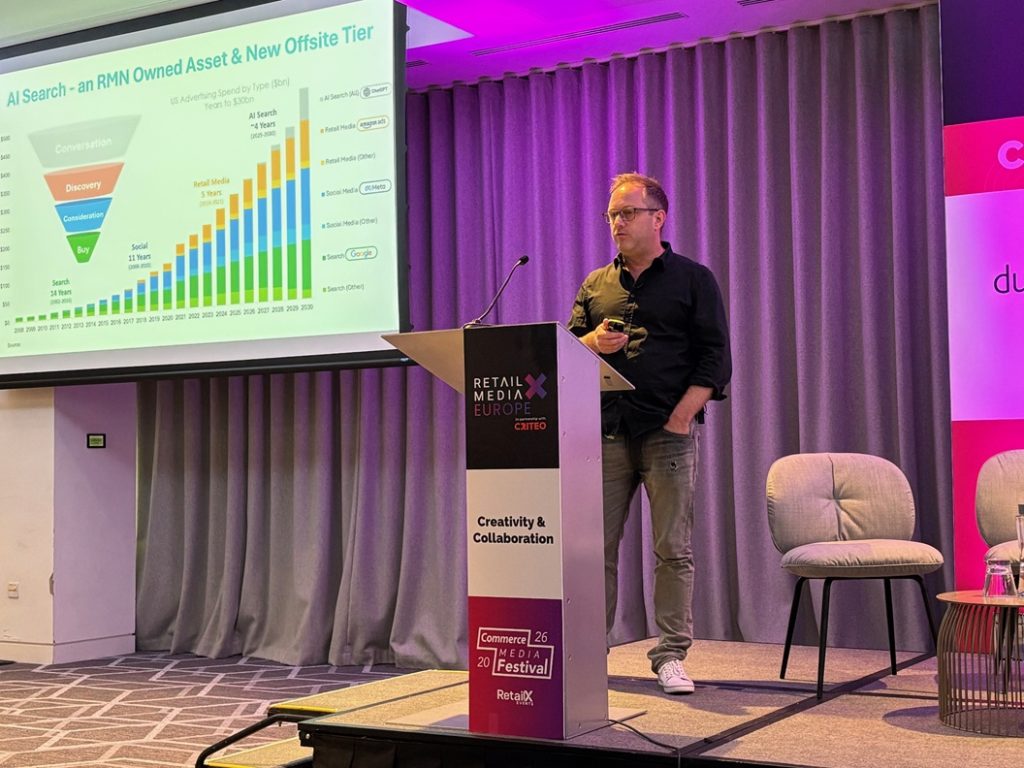
In the first session of the expo, Roger Dunn, Chief Commercial Officer at AI ad tool Thrad and former Global Retail Media Lead at Diageo, spoke about what will form the foundations of the “next phase” of retail media growth in 2026 and beyond.
Dunn laid out ten factors that he believes will define retail media’s scale and evolution going forward – each of them with a link to AI.
1. Offsite goes upstream
Retail media, said Dunn, addresses the full funnel from discovery and consideration through to sales. And now there is a new conversation layer happening on top – pre-defining products, pre-defining shopping and discovery.
Retail media players need to think about this from two perspectives: first, how can they push their programmes into this nascent offsite space? And secondly, how can retailers bring this type LLM experience onto their own site and make this an owned space?
2. Truth beats scrape
Dunn pointed out that when large language models scrape the online ecosystem, this is a static snapshot that doesn’t represent real-time data or shopper behaviour. By contrast, retailers have access to a wealth of real-time data about products, inventory, transactions, interactions. This puts them in a position of strength.
“So, LLMs can tell you what product you want to buy, potentially – but the retailer is the only one that knows that’s in stock and can deliver it to you.” As a monetisable asset, Dunn concluded, this data is key.
3. Stories beat keywords
Up to now, retail media has centred around keywords: bidding for and winning the key positions on-page so that brands can grab prominent real estate in front of the shopper.
However, with prompts and more conversational queries increasingly driving search, Dunn observed that the long tail can finally be addressed. He anticipates that there will be more demand, particularly from smaller businesses, for products that are further down the catalogue in order to satisfy those very specific searches – and that this will be another growth area that will see more demand and more opportunity for brands to participate.
4. The reactive billboard
AI is enabling a new type of personalisation with digital out-of-home billboards: Dunn shared an example from Argentine online market Mercado Libre in which reactive screens could put ads relevant to the consumer’s situation and context in front of them.
A camera in the billboard is able to detect what is happening in the crowd around it, and real-time analysis combined with access to Mercado Libre’s product catalogue can deliver personalised ads to whoever is closed to the billboard. For example, a person walking a dog might receive an ad for pet food – complete with a QR code that lets them shop the product on Mercado Libre.
“Obviously, there’s a line here in terms of how much you want to be personalised in this type of environment,” Dunn said – as always, personalised experiences need to walk a fine line between feeling relevant and potentially coming across as intrusive. However, “As long as it’s done at a high level, it can be quite a powerful way to bring another AI experience into digital retail media.”
5. Bid as one
Some retailers are now aligning with brands in order to present the shopper with a shared ad not just for a brand, but for a brand sold through a specific retailer.
For example, Target and Lindt have collaborated on ad placements within ChatGPT – “So, they’ll have the budget and the products from the brand, and they’ll bid through the Target account to buy ads in ChatGPT.”
Dunn predicted that this type of collaboration on offsite inventory will become increasingly important in retail media. Interestingly, this also presents a way for an ad to drive sales to a specific retailer even when the placement is offsite and therefore not on their ecommerce real estate.
6. Inside the chat
Harking back to Dunn’s point about a conversational layer on top of offsite experiences, the sixth element of his list focused on bringing the retail store into chat platforms such as ChatGPT.
Retailers such as Walmart and, again, Target have launched dedicated app experiences within ChatGPT. These types of apps have become more of a focus for enabling shopping on ChatGPT since parent company OpenAI pulled back from Instant Checkout, which was originally designed to enable seamless purchases within ChatGPT. Instead, purchases complete on the retailer’s website via an in-app browser within ChatGPT’s mobile app or through a browser tab on the web.
Dunn highlighted that this is a new space that hasn’t been developed much thus far – but with a lot of interesting potential. It raises questions such as: how might sponsored products appear within these apps?
7. Every SKU activated
Dunn suggested that AI has numerous efficiency benefits to offer that can make it easier for brands to invest in retail media – particularly those who might have fewer resources or lack agencies to assist them.
For example, generative AI tools can collapse the cost of creating great product pages and ads, power build-outs of product detail pages, and automate retail media optimisation, thereby delivering an easier solution for many brands.
8. From keywords to conversations
Dunn used the analogy of ice cubes and snowflakes to compare keywords against conversational prompts: ice cubes, he said, are mass-produced and uniform, whereas snowflakes – like AI prompts – are “infinitely complex”.
“They’re unique – we’re talking about 60, 120 words in a prompt or a full conversation,” he said. “The granularity of that experience is obviously a lot more specific and tailored.” This opens up almost “unlimited” opportunities to monetise long-tail queries and present products to solve these consumer problems.
9. Own the conversation
Remaining on the theme of conversation, Dunn emphasised that chat agents like Amazon’s Rufus or Walmart’s Sparky are “brand-new real estate” for retail media – and for retailers, present an opportunity to own the conversation.
It’s not just the major players who are launching these agents – they’re now being launched by retailers across every kind of vertical, even down to a specialist guitar retailer like Guitar Center, which launched an AI assistant called Rig Advisor.
Consumers are using these assistants to conduct highly-specific, high-intent and high-context searches – “so [when] serving a product into this space, the efficacy is going to be really high. The results are going to drive sales … So ads in these spaces have high value, too.”
For a deeper dive into the emerging phenomenon of advertising in chat agents and conversational retail media, read RMA’s recent piece: What would conversational advertising mean for retail media, and can it succeed?
10. The AI Joint Business Plan (JBP)
Dunn put forward that joint business plans (or partnerships) between brands and retailers, known as JBPs, need to evolve with the new opportunities being presented by AI.
He broke this down into three ways that brands and retailers should be partnering:
1: Be found (Joint discovery)
Dunn suggested that brands and retailers should collaborate and pool their efforts in AEO/GEO optimisation as well as LLM brand audits and share of model; and ensuring data is structured and machine-readable.
2: Be the answer (Joint placements)
This encompasses brand investments into retailer AI assistants as well as collaborative placements in LLM platforms like ChatGPT, and even combining generative creative programmes.
3: Be the destination (Joint platforms)
Retailer apps within LLMs should showcase brands and make sure that product information and positioning is right; UCP (Universal Commerce Protocol) and ACP (Agentic Commerce Protocol) should also be approached jointly by brands and retailers as they think about how to win in agentic commerce and how to plug into that world.
Finally, Dunn argued that brands and retailers should jointly ensure that their data and measurement is AI-ready.
“Obviously, this doesn’t replace the traditional JBP – but it feels like there are new areas that we need to start thinking about and working together on,” he concluded.
For even more insight into the defining shifts that will shape retail media’s future, don’t miss this write-up from RMA’s most recent editorial board meeting: The shifts that will define the next stage of retail media? Buying efficiency, brand, and commerce