Once a part of experimental innovation budgets, retail media is growing up and having to prove itself – and that means delivering measurable performance.
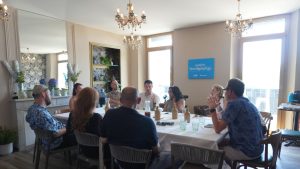
This was one of the key takeaways from the latest meeting of Retail Media Age’s editorial board, which brought together leaders from retail media platforms, retailers, and industry bodies to discuss what they see as the most pressing issues and questions in retail media.
From economic pressures to the ever-present question of AI’s influence to how brand equity is coming to the fore, the discussion covered a wide ground while getting to the crux of some of the biggest challenges currently facing the industry as it goes through a critical phase of maturation.
Shifting budgets, pressured brands
One of the biggest ongoing themes that members agreed on was the considerable pressure that brands are under to improve their top line – or even just to stop their bottom line declining. Dean Harris, Head of Co-op Media Network, noted that “brands are getting really squeezed on efficiency”.
“The language I’m consistently hearing is ‘efficiency, budget pressure, performance proof’. Brands are trying to anticipate further disruption in their markets and are being far more deliberate about where they invest,” he said.
“Historically, brands structured their budgets to balance certainty and experimentation. The majority went into proven drivers (70%), a meaningful portion into informed experimentation (20%), and a smaller share into emerging opportunities (10%).”
“What we’re seeing now is more investment concentrating into proven activity, with proportionally less budget available for experimentation and emerging opportunities.”
This is creating a material challenge for retail media networks, which depend on brands having the confidence to invest beyond the most immediately provable activity.
Alex Prouhet, Director of Offsite Digital Media & Trading at Nectar360, added that as retail media has moved beyond the initial hype cycle, spend “isn’t coming from innovation budgets any more – it’s coming from working media budgets; and it has to perform against all other media types.”
With that said, although retail media has unquestionably matured in recent years and many organisations’ use of the channel with it, other retailers are just entering this space. For those retailers at the very start of their retail media journey, participants noted that it can still be a challenge to educate vendors on what retail media is and what its benefits are.
Jill Orr, SVP GtM at Criteo, added that the same existential challenges are facing agencies as well as brands. Agencies have smaller teams working on each account – and as a result, “it’s not just the budget, it’s the time. [Retail media networks] are fighting for the time of that small team – and time equals efficiency.
“Agencies want to shift dollars – but they want to know how efficient it is to buy that media and then scale it.”
Does retail media have a buying efficiency problem?
There was a lively debate among members of the advisory board as to whether retail media has a buying efficiency problem – that is, whether it can really be bought as efficiently as other types of media.
Orr said that brands and agencies are “trying to justify and support the concept of a larger retail media market – but they’re unintentionally coming up against significant barriers about how to make that cost-effective.”
In Orr’s view, “If you look at how efficient – and how sophisticated – buying media [more widely] is, and then you look at retail media, it’s not even in the same stadium.”
However, Harris put forward that the real issue to be solved was ease. “Buyers quite rightly want greater standardisation and comparability, and some level of alignment across the market is clearly part of the answer,” he said.
“The risk is when standardisation tips into full commoditisation. If all inventory becomes directly interchangeable, you inevitably move into a pure price-comparison dynamic, which quickly becomes a CPM battleground.”
He added that a retail media market made up of completely opaque, non-comparable walled gardens isn’t viable either. “The challenge – and the opportunity – is finding the right balance: improving ease and interoperability for buyers, while still allowing retailers to express genuinely different propositions.”
Prouhet suggested that the walled-garden, closed-loop proposition offers a distinct approach versus “media as a commodity”, where media is bought across different retailers – and that there are useful learnings from the publishing industry on how to operate effectively at scale.
He added that these two approaches will resonate with different advertisers for different reasons, and that increasing flexibility and choice for buyers would help the market to meet a wider range of objectives.
Olivia McCullagh, Head of Retail Media at IAB UK, said that there is still a lack of education between media owners and agencies who have suddenly found themselves in a retail media world, trying to understand its tools and players.
“They’ve been given these self-serve tools, they’re being shown that this is omnichannel; but there’s still a differentiation between the media planner and the agency team who don’t fully understand how each other works,” she said.
Meanwhile, the landscape is complex, sometimes with only slight nuance between players, and navigating it can be challenging even for those who work in the industry.
With that said, this is likely to shift as retail media matures. As McCullagh posited: “In four years’ time, will a brand just be working with three networks?”
The ‘MySpace era’ of agentic commerce: How AI is really impacting shopper journeys
All the while, industry professionals are conscious that the buyer journey is currently changing in dramatic ways – and there is a need to try and anticipate exactly what the impact will be on retailers, brands, and retail media.
Orr stated that agentic commerce is “just another channel” – but one for which the mechanisms to capitalise on it are very different.
“It feels like the same [type of shift] as email, as Google; it’s like we’re in the MySpace era of agentic commerce.”
Customer buying behaviours also vary across verticals – such as beauty, luxury, grocery, or DIY and trade – and so the level of impact from AI or agentic may depend on how that journey unfolds. Grocery and luxury shopping, for example, are still largely carried out in person – albeit with research increasingly conducted online.
Lucie Leverton, Head of Partnerships at Harrods, said that “For high jewellery [£100,000 per piece], you’re not necessarily going to start that journey online, but for fine jewellery [£3,000 to £10,000] customers probably will start the buying journey online – so that’s where we might find that AI search tools kick in.
“But ultimately, the transaction’s probably still going to happen in the store, so we still need to track that journey from start to finish.”
Orr also recounted the experience of using AI assistance to look for a new bike and being recommended small bike shops in distant cities – rather than established retailers she was familiar with in her local area. “What I really wanted was a recommendation of a bike shop that I’d heard of, or at least that was near me,” she said.
“That mechanism doesn’t work right now on those surfaces. … It’s moving quickly, but the experience is really fragmented.”
Brand-building could define the next phase of retail media
Harris suggested that AI may shift the role brand equity plays in decision-making. “Historically, brand familiarity helped you get into consideration, and then product relevance or visibility helped you get chosen.
“With AI-led journeys, that sequence may flip: the system surfaces a solution first, and brand familiarity then plays a reassurance role by helping shoppers trust that the recommendation is credible and safe.”
He added: “Brand equity doesn’t disappear in that world, but it may become less about driving discovery and more about validating decisions.”
The attendees talked about the increasingly important role of brand in retail media and in the shopper journey generally, with Nectar360’s Prouhet predicting that the conversation about brand-building will frame the next few years in retail media.
“[The question will be] how are you creating products that are demonstrably brand-building – and that complement the transactional element of ‘Did that get a sale?’”
Another element of retail media that’s increasingly coming into focus is creative effectiveness. Harris noted that, particularly at industry events, brand interest is increasingly centred on how creative performs within retail environments.
“Retail media often operates in environments with reduced ad attention, but extremely strong context,” he said. “The challenge for brands with creative is making the most of a very small window – effectively delivering a one-second pitch to the shopper.”