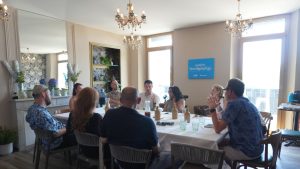
As retail media transitions from an experimental budget line to a core commercial engine, the industry faces a pivotal year of structural transformation. To explore the hurdles and opportunities ahead, the Retail Media Age advisory board recently met for a roundtable discussion.
The discussion featured Justin Pearse, Editor-in-Chief, Retail Media Age; Ellie Edwards-Scott, Associate Publisher, Retail Media Age; Jason Wescott, Global Head of Commerce Solutions, WPP Media; Marie-Clare Puffett, Industry Development and Insights Director, IAB Europe; and Uche Ofili, Director of Agency Partnerships, SMG.
From Experimental Add-ons to Core Commercial Priorities
The overarching sentiment of the discussion was that the “experimental” phase of retail media is firmly in the rearview mirror. What was once seen as a secondary revenue stream for grocers is now a sophisticated, full-funnel marketing solution.
Justin Pearse opened the session by noting how rapidly the conversation has matured, stating that “retail media has moved fast over the past year, shifting from an experimental add-on to a core commercial priority for retailers, brands, and agencies alike.”
This professionalisation is being met with internal structural changes within major retailers. Uche Ofili observed that retailers are now far more willing to talk about retail media, but that requires changing behaviours inside big organisations. He said that retail media is now being broken out as its own component in major RFPs, signaling that it is no longer buried within traditional trade marketing budgets.
However, Ofili cautioned that while retailers are trying to turn themselves into traditional media owners, they are facing significant growing pains.
“They’re not so much speedboats as oil tankers,” Ofili suggested, highlighting that the professionalisation of the space is being met with internal “red tape” as retailers reconfigure their logistics to behave like media companies.
The Urgent Quest for Standardisation and Trust
As the sector scales, the lack of uniformity has become a primary hurdle. Fragmentation across different Retail Media Networks (RMNs) often forces agencies to navigate a maze of disparate metrics.
Puffett emphasised that for the industry to reach its next stage of maturity, it must align on common ground. “As the ecosystem matures, we’re seeing a real need for shared standards, consistent measurement, and greater collaboration across stakeholders,” she said, pointing to IAB Europe’s work on the Retail Media Certification Programme.
This call for transparency is not just about convenience but about the long-term sustainability of the sector. Marie-Clare explained that the industry must move toward the same level of accountability as traditional digital media, embracing “independent verification” and “measurement comparability.”
Wescott supported this, suggesting that the “golden ticket” of retail media, first-party data, is only as valuable as the framework used to measure its impact. He warned that if retailers cannot offer the level of flexible access found in other digital channels, they will eventually lose out.
“If we can’t buy these in the way that we want… we’re not going to buy these formats,” Wescott asserted, adding that ultimately, “the retailers are the ones who are going to lose out.”
The Physical Store as the New Digital Frontier
While much of the early noise in retail media focused on on-site search, the roundtable participants were quick to point out that the physical store remains a powerhouse. Puffett noted that with the vast majority of retail sales still happening in-person, “in-store retail media is not the same as digital out-of-home (DOOH).”
She explained that the physical environment offers unique “formats and creative solutions” that have a more direct impact on shopper behaviour at the point of purchase.
Wescott highlighted how the industry is now bringing a commerce lens to traditional media channels like DOOH and connected TV (CTV).
He said that consumers now expect to be able to convert wherever they are in their purchase journey. “It’s about proving that these channels can do more than build awareness; they can drive tangible business outcomes like sales, store visits, and basket size,” he said.
Ofili added a layer of nuance to the in-store discussion, citing the risk of traditional point-of-sale (POS) carrying risks if not managed correctly.
He suggested that “the temptation to chase revenue will always exist, especially under commercial pressure, but my hope is that the industry does not compromise the consumer experience.”
The ‘Agentic’ Future and the Role of AI
Looking toward 2026, the board identified Artificial Intelligence as the most significant disruptor. Wescott predicted that we are entering “the year of agentic commerce,” where Large Language Models (LLMs) could fundamentally alter the customer journey.
He expressed concern that LLMs could potentially “cut retailers out of the loop,” owning the customer journey and facilitating purchases without the consumer ever interacting with the retailer’s traditional interface.
Puffett raised a “red flag” regarding how this might impact the broader industry. If AI becomes the primary interface for shopping, she questioned how it would fund the wider ecosystem, including journalism.
She stressed the importance of looking holistically at what this shift means for the industry’s long-term health.
From a practical creative standpoint, the board saw AI as a tool for efficiency. Wescott argued that this enables a shift from “creepy” hyper-personalisation toward “localisation,” which helps brands “cut through the noise” without invading consumer privacy.
Integrating Talent and Overcoming Internal Silos
A significant portion of the discussion centered on the “human” element, partnerships, education, and strategic alignment. Uche Ofili argued that the role of agencies is changing to become the gateway to scaled investment in retail media.
“I genuinely believe agencies will be the gateway to scaled investment in retail media in 2026,” he stated.
Puffett observed that the recruitment landscape for retail media is currently a “minefield,” noting that most professionals come from either a retail or a media background, but rarely both. Jason Wescott agreed, adding that there is an increasing need for “business generalists” with strong acumen who can navigate the complexities of these new commercial models.
The board discussed the rise of “Heads of Integration” roles on the client side to close the funnel. Wescott cited examples where the full potential is not met because of the lack of alignment.
He predicted that by 2030, humans will focus on “strategy that actually moves the needle,” while AI handles the technical execution.
As the roundtable drew to a close, the consensus was clear: the next two years will be defined by the industry’s ability to prove tangible business outcomes like sales, store visits, and market share.