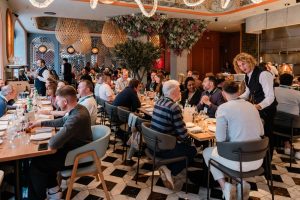
A sunny afternoon in mid-July saw specialists from across Manchester’s retail media industry gather for insights, networking, and discussion at the second Retail Media Age community lunch.
Headline partner Epsilon and supporting partners Koddi and Appsflyer helped to make the day possible, and Retail Media Age would like to thank them for their generosity and support, which was integral to the success of RMA’s first event in the north.
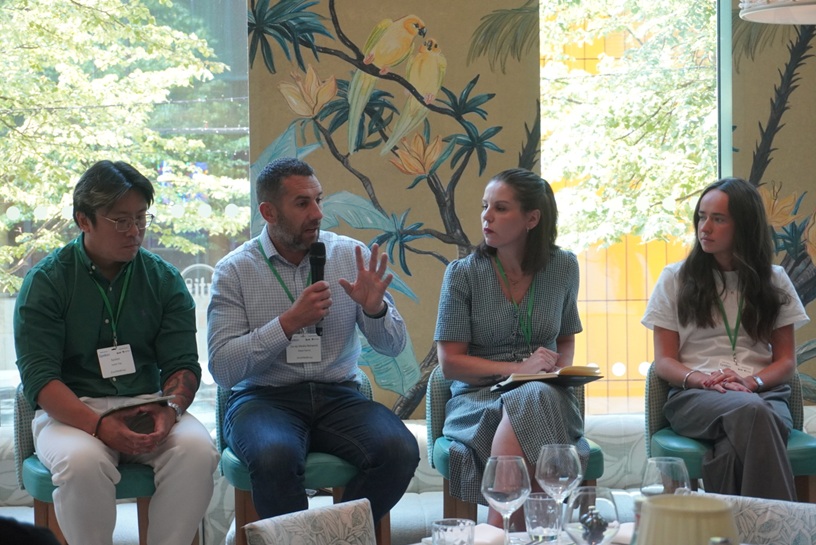
The event was headlined by a panel discussion that brought together perspectives from different parts of the industry – from retailers and retail media networks to agencies and tech specialists – to consider how retail media can move forward as a channel following remarkable growth.
As RMA Editor Rebecca Sentance said while introducing the discussion, “Over the past few years, retail media has rapidly expanded as a channel, as we’ve seen through numerous banner growth figures. But this has also brought about challenges, such as the much-discussed issue of fragmentation.
“Currently, retail media is at something of an inflection point; so how can retailers, brands, agencies and tech partners alike take advantage of the opportunities it presents while avoiding the pitfalls?”
No longer “why” – but “how big can this become”
The panel discussion started off on a note of optimism as each panellist spoke about what excited them about the present moment in retail media.
Justin Tay, VP Commerce at Epsilon, pointed out that over the course of the last several years, retail media has gone from solely comprising on-site performance to offering closed-loop measurement from offsite and in-store placements. “It’s not about ‘why retail media’ any more – but ‘How big can this become?’” he said.
With that said, the growth headlines that surround retail media have brought with them heightened expectations for performance and delivery, and Tay warned that this pressure is at risk of stifling nascent retail media players before they can develop.
“It’s like joining McClaren as Max Verstappen’s teammate – not everyone has the same car, the same engine or the same driver,” he said. Things like incrementality and customer lifetime value may not be deliverable from day one, but newer retail media networks will still be competitive if given the space and resources to grow.
Heidrun Thrainsdottir Kelly, Director of Retail Media at dentsu, noted that retail media has gone from a tactical line on the media plan to a core part of clients’ media strategies, the upshot of which is that agencies like dentsu are being brought into conversations earlier so that retail media can be considered as part of the wider media mix.
She added that clients are expecting the same level of accountability and strategic thinking from retail media that they get from established media channels. “Rather than asking, ‘Can retail media deliver sales?’, they’re asking, ‘Where does retail media deliver the most value – and how should it work alongside our other channels?’” she said.
Emelia Lavery, Retail Media Manager at THG Ingenuity, echoed this, recalling a shift in perception during the time she has worked in the space. “We’ve gone from spending time explaining what retail media is and why brands should care about it to having much more strategic conversations about how they can use it.”
The fragmentation question
The challenge of fragmentation in retail media, arising in part from rapid growth and a proliferation of new players with different propositions in a short period of time, has been discussed for years without an obvious solution.
However, Dean Harris, Head of Co-op Media Network, pointed out that the word ‘fragmentation’ is bandied about so often that it’s in danger of losing all meaning.
Instead, he reframed the issue in terms of three “budgets” that media buyers have – not just a “money budget”, but also a “time budget” and a “frustration budget”. Removing barriers to speed and efficiency, therefore, can save advertisers from exhausting their ‘budgets’ across multiple axes.
The panel agreed that retail media has had comparatively less time to tackle these issues compared with media channels such as programmatic or digital display, which have enjoyed more investment and more opportunities to consolidate in a way that alleviates fragmentation.
However, there are downsides to consolidation: Harris pointed out that for media publishers, it has led to the loss of control over proposition, price, and differentiation. Retailers are wary of this, and so are keen to own the aggregator role.
“The demand-side proposition for aggregation and comparability is obvious,” he concluded. “But the supply-side proposition isn’t yet. If that can be solved, I think market forces will remove fragmentation.”
In the short term, Lavery highlighted that better collaboration across partners can tackle the drawbacks of fragmentation. “Even simple things like improving communication between retailers, agencies and tech partners can reduce duplication and create a smoother customer journey,” she said. “When we make these small changes, we’re on the right path to making retail media easier to stitch together.”
Kelly reflected on the role of agencies in helping brands to buy efficiently amid fragmentation. With so many different retail media opportunities to choose from, she explained that agencies must help brands to invest in the right networks rather than trying to be present across all of them.
“To do that efficiently and at scale, we need confidence in the data we’re using to make those recommendations,” she said. “The biggest change I’d like to see is greater consistency in measurement, reporting and attribution across retail media networks.”
Retail media measurement: Is the bar being set too high?
The modern-day customer journey is itself a fragmented one across numerous different touchpoints, from channels like social media (which is increasingly coming into its own as a buying channel) to search, generative AI assistants, and of course retailers’ ecommerce sites and stores.
The panel discussed how retail media measurement can meet this challenge, with Tay asserting that the industry needs to be able to “walk and chew gum at the same time” – innovate while making sure the basics of effective attribution and measurement are taken care of.
Echoing this, Kelly highlighted that agencies must build confidence in measurement and have a shared understanding of what success looks like before they can tackle more ambitious questions like measurement across the full funnel, off-site attribution, and in-store.
“We need to build the foundations before adding floors to the rest of the house,” she said.
Harris pointed out that paradoxically, retail media’s biggest attraction – its power to measure and attribute returns – has also somehow become its most frequently-cited shortcoming. “We have a tendency to criticise the distance from perfection rather than acknowledging the progress that has been made relative to the past,” he said.
Retail media represents significant forward progress in terms of the ability to close the loop on media attribution; arguably, we should appreciate this even as we push towards a future with greater connectivity across the customer journey.
‘Avocado toast’: the real impact of AI in retail media
The conversation touched on the question of how much AI is really impacting shopping behaviour. While the hype around agentic AI might lead us to believe that retailers will be advertising to bots in a few short years, how does this really compare to what the panellists have seen in their day-to-day work?
In a memorable comparison, Tay likened the arrival of AI to “avocado toast”: “No-one knows exactly where it came from, but suddenly, it’s on every brunch menu.”
But while AI might be the topic du jour, he emphasised that the human element is still key, with fully-fledged agentic shopping still a way off. Even though AI has squeezed the discovery portion of the funnel, the ultimate purchase still very much relies on a person with deeply human psychology.
Harris predicted that the real impact of AI’s transformation is still a long way off, pointing out that when electricity was first introduced, people anticipated “better candles” – not at all foreseeing the complete technological revolution that it would bring about.
However, he noted that behavioural change is rarely as fast as technological change and encouraged industry players to experiment without losing sight of the fundamentals that still drive brand growth.
The conversation concluded on a deeply human note as panellists reflected on what they would want to see from retail media’s community going forward. Lavery advocated for continued openness and collaboration across the industry, recalling, “Some of the best conversations I’ve had have been where retailers, brands, agencies and technology partners have been honest about what’s working and what’s not.
“Retail media is an evolving channel, and we’re all experimenting and learning together.”
She also echoed a call from Kelly for “More events in the north”, which was underscored by Tay, who asserted that, “Manchester will be the new London.”
The energy in the room was a testament to the industry’s enthusiasm to innovate and tackle the challenges before them – and Retail Media Age is proud to be playing a part in bringing retail media’s community (in Manchester, London, and beyond) together for these critical conversations.
Retail Media Age’s next lunch is taking place on 10th September at Osteria by Bocconcino, London – book your place now.