Retail media has officially outgrown its infancy. Having spent the last half-decade experiencing unprecedented, explosive expansion driven by a rush for first-party data and net-new digital ad revenue, the sector is entering a far more mature and demanding chapter.
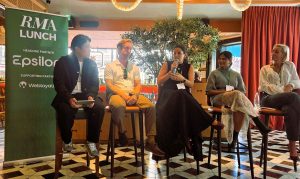
In Maison New Digital Age at Cannes Lions, a group of industry leaders gathered to discuss retail media’s next phase: how to move beyond the ‘hype’ of growth and tackle urgent questions of fragmentation, measurement, customer experience, and more.
The discussion was chaired by New Digital Age and Retail Media Age Editor-in-Chief Justin Pearse and was made up of senior leaders representing major retail media networks, platforms, and organisations. Joining the discussion were Ollie Shayer, Senior Director, Global Strategy and Innovation, SMG; Jill Orr, SVP GTM, Criteo; Ellie Prendergast, Founder, Women in Retail Media; Martin Ditlev Nielsen, Global Head of Media Strategy & Planning, Arla Foods; Shane Buckley, UK Country Co-Lead, Uber Advertising; Simon White, Sales Director UK & Nordics – Retail Media, Mirakl; Kavita Cariapa, Head of Commerce Media, EMEA Global, Dentsu; Justin Reid, Senior Director of Media, Tripadvisor; and Suzy Knight, Partnerships Lead, Screwfix.
“We’ve got over the hype that defined retail media”
The conversation opened with a look back at retail media’s rapid trajectory.
For years, retail media networks sprouted almost overnight, each promising unique access to closed-loop transactional data. However, the sheer fragmentation of the marketplace has forced a major strategic pivot, moving away from opportunistic land-grabs toward long-term business sustainability.
Ollie Shayer of SMG framed this evolution by highlighting that retail media is moving past its initial four-to-five-year high-growth phase. He said that the market is now seeing a massive influx of new retailers and commerce media partners across diverse verticals.
Networks that want to remain successful must now focus on what it takes to reach the next tier, including making serious corporate investments. “Those partners who want to be successful are looking at what it’s really going to take to go to the next level of that,” Shayer said.
He added that he expects the market to mature to a point where retail media is simply planned and bought under the broader umbrella of standard ‘media’, losing its dedicated moniker.
Orr echoed Shayer’s view, pointing out that retail media networks are developing at vastly different speeds. She said that a network’s scalability depends on recognising where it sits on this uneven maturity curve.
“You have to remember that everyone is running a different race as they enter the market,” Orr said, adding that platforms must look closely at their own operational maturity to understand what it takes to survive long-term.
This structural shift requires a deeper appreciation of the actual customer journey rather than a narrow focus on immediate clicks.
Ellie Prendergast at Women in Retail Media emphasised that true omnichannel integration remains the ultimate goal. She says that while current industry operations are largely multi-channel, the future relies on successfully connecting digital off-site and on-site activations directly with the physical, in-store environment.
“Shoppers don’t just shop online or in-store,” Prendergast said. “We need to connect it to the in-store environment and have true omnichannel as well, so you [can] understand how things perform in different environments.”
Martin Ditlev Nielsen of Arla Foods agreed that the market has cleared its first major hurdle by surviving the initial wave of hype.
“We’ve got over the hype that defined retail media just a couple of years ago,” Nielsen said. He said that the industry is entering a stabilisation phase reminiscent of early digital marketing transitions. According to Nielsen, brands now require a much higher level of programmatic standardisation across ad placements to justify their continued investments in these environments.
The programmatic shift and marketplace fragmentation
As retail media scales, manual operations are becoming an insurmountable operational bottleneck. Agencies and brands are demanding the same ease of execution, automation, and tech-driven efficiency that they enjoy on mature channels like programmatic display, search, and social.
Shane Buckley of Uber Advertising pointed out that both the underlying purchase mechanics and the actual inventory are transforming rapidly. He said that networks must build simpler systems, driven by robust APIs, to ensure that buyers can transact effortlessly.
Buckley also said that the definition of retail media inventory is moving away from traditional ad units toward off-site activations and highly-creative, value-driven consumer experiences.
“I think what people are buying is changing from the traditional units,” Buckley said, adding that modern platforms must “offer enterprise-grade, plug-and-play advertising technology rather than makeshift, unstandardised systems” to meet agency expectations.
The explosion of marketplace models has added another layer of complexity to this landscape, creating distinct requirements for different types of sellers. Simon White of Mirakl highlighted how the rise of these third-party environments changes the media dynamic.
He says that while highly-tailored, creative formatting is essential for first-party wholesale brands, it becomes less important for third-party marketplace sellers.
“When you are looking at your third-party sellers, that becomes less important,” White says. He pointed out that these sellers are digitally native and entirely used to pay-to-play mechanics, meaning their main priority is simple, scalable tools that help them bid for the top of the search page across as many marketplaces as possible.
“Are we actually moving market share?” An outcomes-focused shift for retail media
One of the loudest debates during the roundtable focused on the tension between short-term metrics like Return on Ad Spend (ROAS) and long-term brand-building. For retail media to earn the respect of corporate finance departments, it must move beyond basic media metrics and explicitly prove how it drives broader commercial outcomes.
Kavita Cariapa of Dentsu observed a structural change within brands that reflects this shift. She said that clients are increasingly looking to insource retail media and commerce capabilities under their own corporate umbrellas. After years of brands deprioritising internal data science and measurement roles, Cariapa pointed out, there is a massive resurgence in hiring for these exact positions.
“We are now seeing our brands and clients reinvesting in these specialised roles,” she said, explaining that the next stage of retail media will be deeply insights-driven. She argued that the channel must shift away from standard media metrics toward tangible commercial outcomes: “Are we actually moving market share? Are we accelerating sell-through? Are we shifting the total checkout receipts at that specific retailer?”
This focus on conversion and hard commercial numbers creates an inevitable internal clash with creative and brand teams. Nielsen explained how this tension manifests inside an FMCG brand, saying that low-margin businesses cannot view retail media solely through the lens of direct conversion.
“Retail media cannot be viewed solely through the lens of direct conversion,” Nielsen argued. “It is equally about driving product trials, promoting new product development, and figuring out how to navigate that space effectively.”
Because commercial and sales teams traditionally control retail media budgets, he stressed that an internal bridge must be built between sales and marketing to ensure that these tactical activations also support long-term brand equity.
Justin Reid of Tripadvisor introduced a strong perspective on this dynamic, highlighting a common disconnect at the executive level. He said that retail media does not represent entirely new marketing budgets, but rather a reallocation of existing funds.
“There is no new money in retail media, it is just moving from one source to another,” Reid argued. According to Reid, corporate CFOs remain strictly focused on the bottom line, often creating resistance to long-term brand building.
Reid illustrated this with a scenario from his own business, saying that leadership often resisted traditional marketing campaigns under the assumption that the brand is already established.
“They say, ‘Our brand is strong, it’s fine’,” Reid said, warning that this mindset leads to a “slow degradation of your brand”.
He said that retail media networks frequently suffer from an internal political divide where commercial teams want every asset to drive an immediate on-site purchase, ignoring the massive financial value of driving traffic off-site to complete a conversion.
The baseline metric infrastructure must also adapt to accommodate these changing strategic priorities. Orr said that the standard economic model of retail media remains dominated by one primary framework. Despite widespread industry interest in exploring alternative business valuations and deeper funnel insights, she said, transactional return remains the universal baseline that retail media networks default to.
”No matter what everybody says,” Orr stressed, “there is a standard measurement in retail media right now which is ROAS, even though everybody loves to talk about other metrics.”
This article is part one of a two-part write-up – continue on to Part 2, Creativity and the Consumer, for the rest of the discussion.