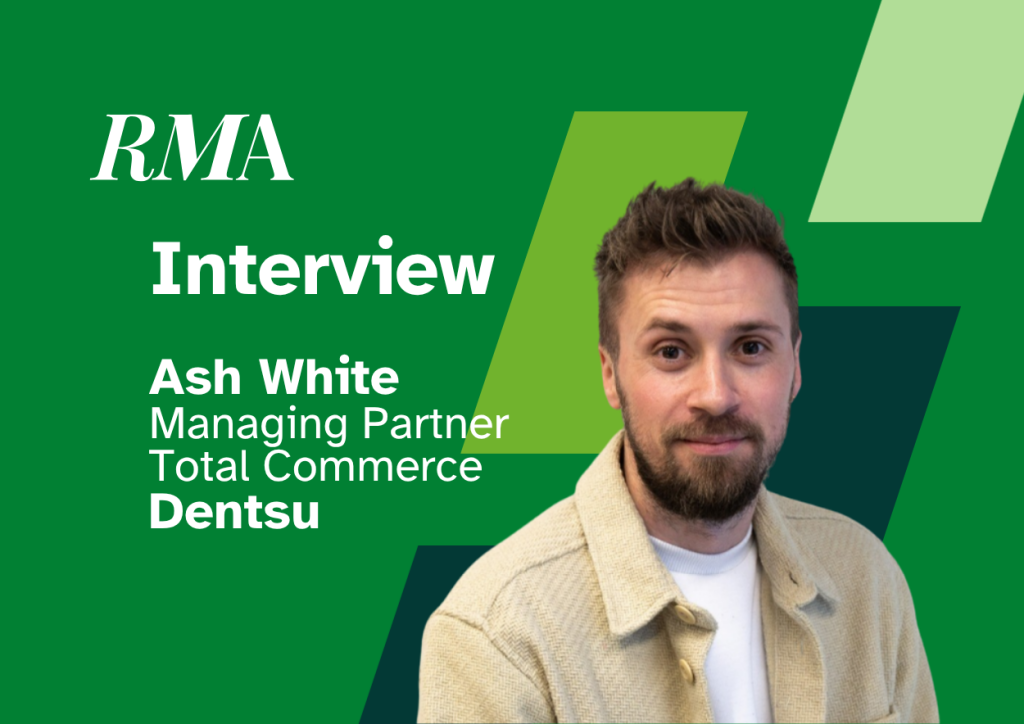
Retail media is becoming less of a standalone discipline and more of a natural part of the wider media mix, according to Ash White, Managing Partner, Total Commerce, Dentsu.
As retail media becomes increasingly integrated with other channels, White argues that its next phase will be shaped by agentic commerce, better measurement and the breaking down of silos between teams and budgets.
Retail media increasingly looks like it is just becoming media. Are you seeing that?
Yes, definitely. We’re seeing retail media activations, briefs and strategy happening much more autonomously throughout the business, with us acting as a connector.
Digital screen networks being established by retailers are increasingly being bought through traditional digital out-of-home buying spaces, for example. Our out-of-home teams are naturally planning and buying that inventory.
Retailers are also being invited into wider media relationships. Client and strategy teams are seeing retail media as part of the normal range of media options available to them. We aren’t having to push the agenda anymore, it is naturally taking shape throughout the agency.
What about creativity? Is retail media finally becoming more creative?
We’re definitely able to brief more creativity. Retailers are much more open to working collaboratively with us to get ideas to take shape.
But my world is probably merging a lot more into agentic commerce at the moment, and that creates a different challenge. You’re effectively future-proofing for agents, and agents don’t necessarily feel as much of the brand and creativity side.
We’re making the most of the creative opportunity now, but at the same time we’re future-proofing against what is essentially a decision maker rather than a brand feeler.
How is agentic commerce changing consumer behaviour?
Agents are becoming a key part of the research process. Based on user intent and what people are searching for on retailer websites, we’re seeing consumers searching with more of a decision already made.
It’s part of the no-click search environment, where consumers search within agents and then move into another environment to complete the purchase based on the research they’ve already done.
For me, agentic commerce couldn’t have happened without retail media. A lot of our clients ask whether they should prioritise agentic or retail media, but the two are almost unanimous in the sense that strong retail media foundations will set you up for success within commerce.
Why is retail media so important to agentic commerce?
Retail media has really shone a light on how brands show up on retailer websites. We’re much more conscious now of how a brand is portrayed on a product page, what the product description says, the imagery, the product title, price competitiveness, ranking and sales velocity.
Agents are utilising all those elements to make their decisions and bring them to the forefront for consumers.
There are things our organic teams would like to optimise for agentic recommendations, but you have to have a retailer relationship to make those optimisations. You’re increasingly asking retailers to optimise their product feeds to better represent your brand in the agentic space.
Does that create a tension between brand building and the more functional information agents use?
It’s much more about the fundamentals of how you portray your brand through those core elements. Product descriptions, FAQs and product reviews are critical.
That is how consumers are feeding back and how you portray the brand in a very black and white manner, rather than through the feel elements we’ve traditionally pushed for consumers.
But brand still matters. The way consumers use agents is still based on confirmation bias. People already have their brand perceptions built into them and they’re probably asking agents leading questions.
So, while agents may become more opinionated in future, today they’re often confirming the research or opinions consumers already have.
Are clients becoming more joined up as a result?
The briefs are becoming a lot more consolidated, which is good, although there are still challenges around silos.
Agentic commerce is shining an even brighter light on that. Multiple departments have to work together to make these developments within media work.
The key thing is that it’s not new media channels redefining media. It’s the lines blurring between them that are really changing the shape.
How is measurement evolving?
We’re seeing retailers recognise that they need to fit within the core media measurement frameworks that already exist. We’re seeing collaboration around the media mix modelling technology that we’re using, with retailers striving to work towards that.
I don’t think we’re quite at the point where everything is about saying ROAS is wrong or we’re in a ROAS trap. We’re finding our feet more around the individual elements of retail media and aligning individual placements with the natural KPIs and media metrics associated with them.
ROAS isn’t going away within sponsored products, but the way it is looked at has evolved. There’s much more recognition of the requirement for incrementality, as well as a more sophisticated understanding of brand versus generic activity and the value of the return being generated.
What about the integration of retail media with the wider media mix?
Budgets are under scrutiny, so headroom analysis and quantifying actual category or share growth, then taking that back to clients in terms of what it means for the bottom line, has been really impactful from a planning perspective.
Audience integration is becoming much more fluid too. People recognise there is a profile audience and a transactional audience, and we’re trying to knit those two elements together.
It’s becoming less surprising to see those audiences and their quantification appearing within overall media planning strategies.
And what about non-endemic brands entering retail media?
They’re naturally finding their own placements and where those requirements exist. EV charging points in car parks are an obvious example because there is a natural association.
We’re now reaching the point where retailers understand how to navigate the legal requirements and which brands they want to work with, including what might be defined as a near-endemic client.
There’s definitely been a renewed push. Non-endemic retail media is coming against briefs much more often, and existing traditional media is also under greater scrutiny. Everyone is having to look at doing things a little differently.
What is the biggest challenge for retail media as it enters its next phase of growth?
The elephant in the room is still the internal silos on the client side and trying to get those budgets more aligned.
It’s not about moving budget from one budget owner to another. When you can demonstrate that one budget pot not only influences another, but also improves that activity, and vice versa, that’s where the silos will start to break down.
Everyone becomes more dependent on each other.
There is still a perception that retail media is money that the brand has to spend, rather than money that is genuinely impacting everything. We need to get to a point where retail media becomes more “heroic” in terms of the overall media planning and marketing.