Retail media is one of advertising’s fastest-growing channels with investment continuing to accelerate. The focus of professional marketers is now shifting beyond audience targeting and measurement towards a more fundamental question: what does great creative look like in a retail media environment?
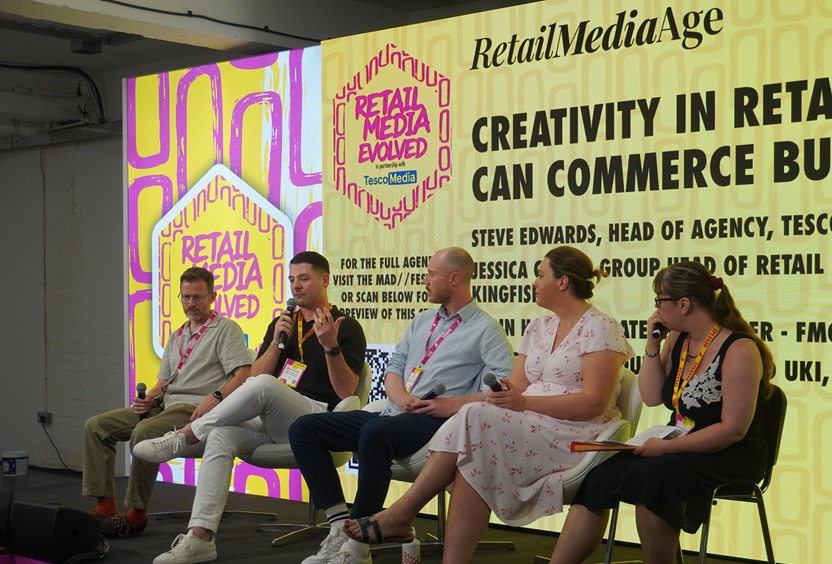
This was the central theme of a recent panel discussion staged at MAD//Fest London 2026. Hosted by Retail Media Age Editor Rebecca Sentance, the discussion featured Jessica Cooke, Group Head of Retail Media Propositions and Partners at Kingfisher; Steve Edwards, Head of Agency at Tesco Media; Shane Buckley, Head of UKI Global Strategic & Enterprise at Uber Advertising; and Colin Horan, Strategic Partner, FMCG, at Bauer Media Outdoor.
While each speaker approached the subject from a different perspective, a common message emerged: creative effectiveness depends on understanding context just as much as data.
For Cooke, one of the biggest changes has been the way retail media is becoming embedded within wider marketing conversations.
“Where those traditional silos between shopper and brand teams are breaking down, and we’re looking at it as one connected conversation throughout the entire planning process, that’s where it’s working really well,” she said.
That integrated approach is helping brands to move beyond treating retail media as simply a conversion channel and instead view it as part of a connected customer journey.
Buckley agreed, arguing that retail media is increasingly earning a seat alongside broader media planning.
“Retail media has traditionally been planned separately from the main media teams,” he said. “As it’s brought more into those conversations, we’re seeing creativity and a focus on where campaigns actually show up come to the forefront.”
For Buckley, the industry also needs to think less about channels and more about customer behaviour.
“Consumers don’t live in channels; they live in moments,” he said. “You need to build creative for the ecosystem you’re in, making it authentic, relevant and additive to the consumer journey, not disruptive.”
Steve Edwards argued that creative remains the single biggest driver of campaign effectiveness, despite the industry’s growing fascination with data and retail media technology.
“Media is only as effective as the creative that gets delivered,” he said. “We’re seeing a much greater focus on creating truly omnichannel campaigns, with bespoke creative that meets both the needs of the brand and the customer.”
Made to measure?
However, Edwards also warned that advertisers need more sophisticated ways of evaluating success.
“One of the biggest challenges is that the objectives and KPIs we’re given at the start are often very different by the end,” he explained. “We need measurement frameworks that reflect the job each touchpoint is actually designed to do.”
Colin Horan echoed those concerns, suggesting the industry’s enthusiasm for data risks overshadowing the creative work itself.
“The danger is that people get obsessed with the data and the targeting capabilities, and creative becomes an afterthought,” he said. “Targeting gets you the placement and the eyeballs, but without strong creative it’s not going to be memorable.”
Instead, he argued, creative should be designed specifically for each environment rather than simply repurposed from other channels.
“Build your creative for the channel and you’ll see around two to two-and-a-half times more effectiveness on things like brand recall and message recall.”
Cooke questioned whether the industry’s tendency to celebrate visually impressive campaigns always reflects what matters most.
“Sometimes you’ll see amazing campaigns that look beautiful and you can shout about them on LinkedIn,” she said. “But are they actually achieving a consumer goal? Are they helping us shift product or deliver the outcome we’re trying to achieve?”
Ultimately, she argued, effective retail media doesn’t need to be overly complicated.
“A beautiful creative that’s relevant for the placement you’re advertising in isn’t rocket science,” she said. “It works. It changes behaviour.”
Good creative needs “human understanding” – even in the age of AI
Artificial intelligence also featured prominently in the discussion, although none of the panellists viewed it as a replacement for creative thinking. Instead, they saw AI as a practical tool for helping marketers cope with increasing creative demands.
“The biggest challenge our clients face is the sheer volume of creative they have to produce,” said Edwards. “Our immediate focus for AI is reducing the friction around production rather than replacing human creativity.”
Cooke shared a similar perspective, suggesting AI could democratise creativity for smaller businesses. “I’m most interested in how it can help smaller marketplace sellers who don’t have big creative teams produce great creative,” she said.
Horan was more cautious, arguing that the emotional intelligence underpinning great advertising remains uniquely human.
“The best creative creates an emotional connection because it has a human understanding of the cultural context,” he said. “I don’t think AI is capable of delivering that just yet.”
As retail media matures, Buckley believes success will increasingly come from balancing commercial objectives with genuine customer value.
“The best retail media campaigns are a win for the consumer and a win for the brand,” he said.
The panel agreed that retail media’s future won’t be determined solely by better data or more sophisticated targeting. Creative relevance remains what ultimately drives attention, engagement and business outcomes.
As investment continues to flow into the retail media sector, the challenge for marketers is becoming less about finding audiences and more about delivering creative that’s worth finding.
Read more of Retail Media Age’s coverage from Madfest London 2026.