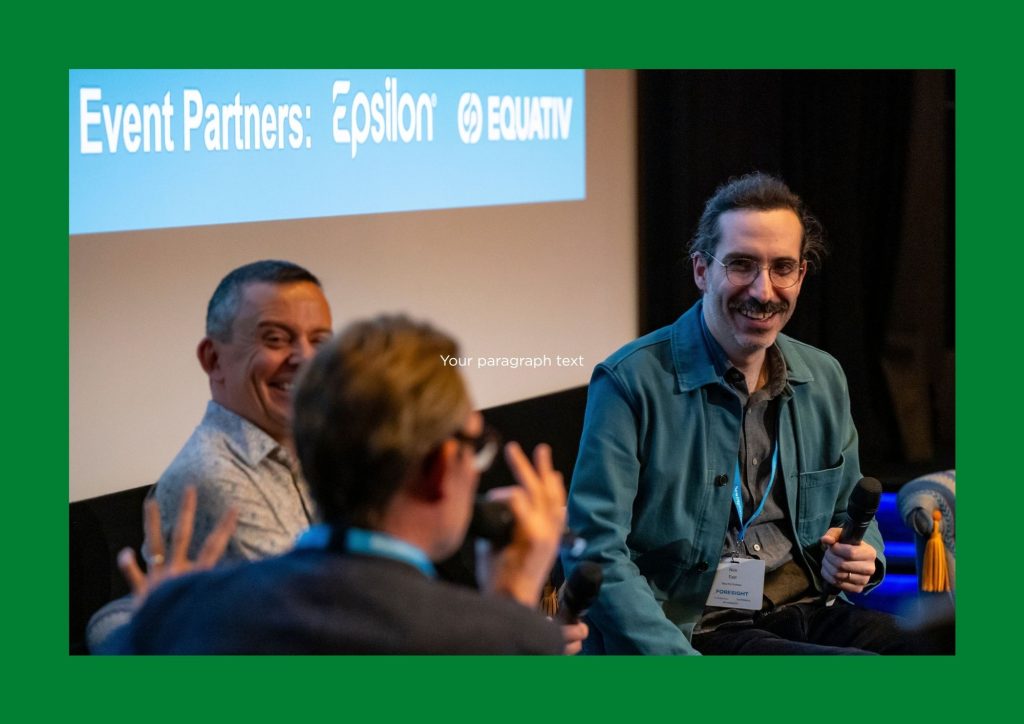
As algorithms, generative AI, and retail media reshape how consumers discover and buy products, senior marketing and agency leaders gathered at NDA’s Foresight conference to discuss a fundamental question: who is truly driving consumer decisions today?
Speaking on the panel at the event, Steve Ricketts, Chief Commerce Officer at Publicis Media, and Nick East, European Head of Retail Media at Mars Pet Nutrition, joined Justin Pearse, Editor-in-Chief at New Digital Age (NDA), to discuss the modern consumer journey.
From the myth of the dead marketing funnel to the double-edged sword of return on ad spend (ROAS), the panel explored how brands can remain visible, authentic, and effective in an increasingly automated landscape.
The illusion of the linear funnel
Much has been made of the collapsing marketing funnel, where a consumer can discover a brand on social media or through an AI assistant and make a purchase in seconds. However, the panel argued that while the speed and channels of discovery have evolved, basic human behaviour remains constant.
As Steve Ricketts said, the rapid transition from awareness to purchase is far from new. “Discovering a brand in seconds and buying it has been happening for decades,” he said. “It used to happen in a physical retailer: ‘Oh, I’ve not seen that one before, I’m just going to buy it now.’ Consumer behaviour is still the same; where they do it and how they do it is changing.”
Rather than abandoning the funnel, Ricketts views it as a necessary framework to make sense of a complex reality. “The funnel doesn’t really exist; people don’t go through those steps artificially. But we need a construct that simplifies all the very complicated things every single consumer does so we can talk about them, make assumptions, and begin to plan.”
Nick East agreed that the fundamental stages of decision-making remain intact.
“Human behaviour hasn’t changed; it’s just shifted in terms of where those interactions are happening,” Nick East said. “The funnel is a planning tool. We keep trying to read its obituary, but it survives because we fundamentally need to create some sort of understanding of what is a very chaotic reality.”
Embracing organisational silos
A recurring theme across industry events is the urge to dismantle internal silos, particularly between brand marketing, trade, and ecommerce. Yet East offered a counter-perspective, arguing that silos are an inevitable reality of organisational structure that simply need clear purpose and management.
“Silos are a practical reality,” he said. “Wherever you move functions like ecommerce or media, you create a division somewhere else. The question isn’t how do we get rid of silos, but what is the purpose of the silo? Once you truly understand that, you can put the processes in place to manage it.”
East added that success comes down to cross-functional collaboration rather than constant structural reorganisation. “It doesn’t matter where the funding comes from, whether it’s trade or brand money, as long as it’s being spent well. What causes a big problem is when it’s run by two different agencies that don’t talk to each other.”
Ricketts emphasised the commercial value of alignment, revealing that connecting these disparate functions yields clear top-line growth. “Where we do two or more of those things for a client together, sales go up 10 to 20 percent,” Ricketts said. “When you join those things up, there are demonstrable results and outcomes.”
Why ROAS is the “refined sugar” of measuring performance
With the explosive growth of retail media networks, performance measurement has become increasingly granular. However, the panellists cautioned against relying solely on short-term metrics like ROAS, which can lead to over-optimisation at the expense of long-term brand equity.
East described ROAS as “the refined sugar of performance measurement,” adding that while it provides quick gratification, it fails to tell the full story.
“ROAS is the most abundant measurement we can use, especially for down-the-funnel activity like on-site search. But for things like display, it’s woefully inadequate. When we sit with leadership, it all comes back to the same thing: sales impact. We need a wholesale culture shift as an industry so the C-suite understands there’s more than just ROAS.”
East pointed to customer lifetime value as a critical, yet underutilised, alternative. “Acquisition is expensive, retention is much cheaper, yet we spend all our time and effort on acquisition and not enough on retention, largely because we can’t measure it easily across ecosystems.”
Ricketts highlighted that ROAS definitions vary wildly across retailers, making direct comparisons misleading.
“If you take Sainsburys’ numbers and Tesco’s numbers from the same digital format, Sainsbury’s defines a sale when you check out and pay, while Tesco defines it by what gets delivered to your house. You cannot compare five-pound ROAS for five-pound ROAS without normalising the data first.”
Navigating AI, ad load, and future discovery
As AI tools like Amazon’s Rufus and ChatGPT become primary search interfaces, the nature of product discovery is shifting from keyphrase searches to conversational queries. Ricketts shared a recent case study where Publicis optimised a client’s product content against conversational intent, such as “find me a nut-free snack for a school lunchbox,” resulting in a 20% rise in unit sales.
However, both panellists warned that high ad loads on traditional retail platforms risk driving consumers toward AI assistants to bypass sponsored clutter.
“If you look on Amazon in a competitive category like TVs or pet food, almost every top result is a paid ad,” East said. “To give shoppers credit, that is one area where they might just say, ‘I’m going to use an AI for this because I don’t trust the ad load.'”
Ultimately, as AI levels the technical playing field, the speakers agreed that core marketing principles will dictate who wins.
“If you haven’t got those basics – decent content, strong star ratings, and a good product – the AIs aren’t going to recommend you,” Ricketts concluded. “You still need the four Ps: a decent product, the right physical – and mental – availability, strong promotion, and the right price. If you get those right, you can succeed.”