Retail media may have dominated marketing agendas for the past three years, but the consensus emerging from industry leaders is that the sector is already evolving into something much broader.
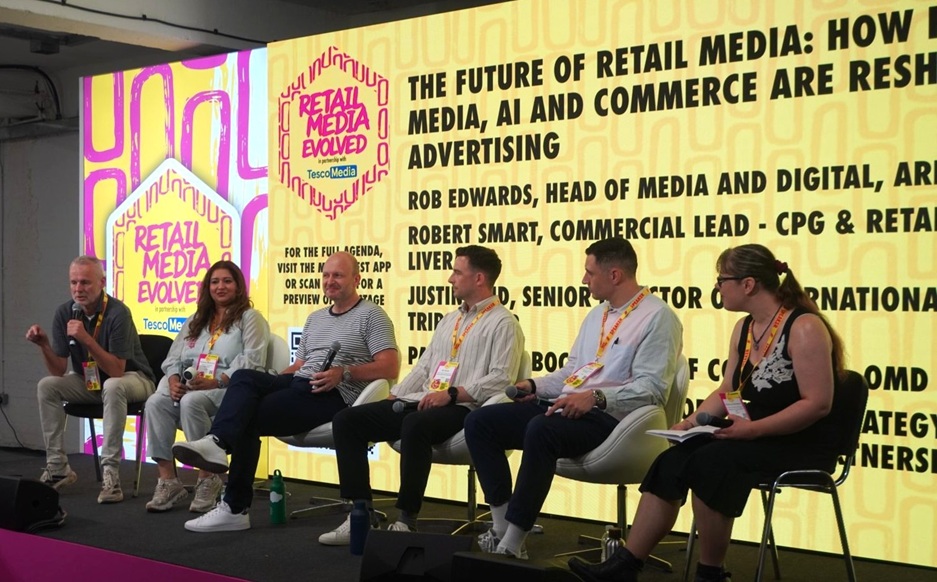
At a recent MAD//Fest London 2026 panel discussion hosted by Rebecca Sentance, Editor of Retail Media Age, representatives from John Lewis Partnership, Arla Foods, Omnicom OMD, Tripadvisor and LiveRamp argued that the next phase of growth will be defined less by retail media networks themselves and instead by connected commerce, AI-powered discovery and a more integrated view of media investment.
For Robert Smart, Commercial Lead – CPG & Retail at LiveRamp, the industry has already outgrown the label that helped establish it.
“The common thread isn’t retail,” he argued. “It’s first-party data: using it to build better audiences, create more relevant experiences and deliver more meaningful measurement.”
As organisations outside traditional retail (from travel platforms to financial services and loyalty programmes) build increasingly sophisticated advertising propositions, Smart believes “commerce media” better reflects the role first-party data now plays across multiple sectors.
That broader perspective was shared by Justin Reid, Senior Director International at Tripadvisor. Speaking from outside traditional retail, Reid questioned whether the industry will need the word “retail” at all in the coming years.
“If we’re calling it commerce media,” he said, “success has to be measured by commercial results.”
His comparison with mobile advertising was telling. Once treated as a specialist discipline, mobile eventually became so embedded within media planning that the qualifier disappeared. Reid suggested commerce media may be following the same trajectory.
Audiences and outcomes
While definitions may be changing, the commercial fundamentals remain remarkably consistent.
Ed Taylor, Retail Media Proposition Strategy & Development Manager at John Lewis Partnership, warned that as commerce media expands into new sectors and channels, the industry risks losing many of the standards it has spent years establishing.
“The more we broaden the definition, the more important it becomes to maintain consistent principles.”
Taylor pointed to the rapid growth of AI-driven traffic as one example of how quickly the landscape is shifting. As consumers increasingly begin product discovery through AI assistants rather than traditional search, retailers and media owners will need to rethink not only media propositions but also the frameworks used to evaluate them.
For brands, however, the conversation is becoming less about channels and more about outcomes.
Rob Edwards, Head of Media & Digital at Arla Foods, argued that the distinction between retail media and the rest of the media ecosystem is becoming increasingly artificial.
“Remove the word ‘retail’. It’s simply media. Every investment should be judged on the audience, the moment and the outcome.”
Edwards described a noticeable shift in retailer relationships over recent years. Rather than simply monetising inventory or relying on proprietary audience data, retail media owners are increasingly adopting a consultative approach, focusing first on business objectives before recommending solutions.
That shift also demands a broader definition of effectiveness.
“Measurement can’t stop at conversion,” Edwards argued. “Brands need to understand the impact of creativity, long-term brand growth and commercial performance together.”
It is a timely observation. Measurement has been one of retail media’s defining debates since the sector began its rapid expansion, yet several panellists acknowledged that many of the same questions remain unresolved. The difference today is that AI, creative effectiveness and increasingly fragmented customer journeys have made the challenge considerably more complex.
Planning the future
Parweez Mulbocus, Head of Commerce at Omnicom OMD, believes those customer journeys demand a different planning model altogether. Planning commerce activity in channel silos therefore no longer reflects how people actually behave.
“Consumers move seamlessly across platforms,” she said. “Commerce planning has to reflect that connected ecosystem.”
Mulbocus sees retail media becoming one component within a wider connected commerce strategy rather than a standalone discipline. That evolution also raises organisational questions as AI-powered shopping accelerates. Responsibility can no longer sit neatly within search, commerce or retail media teams alone.
Technology featured throughout the discussion, but perhaps the most interesting observation was that AI may have less impact on advertising itself than on content.
For Edwards, discoverability is becoming the new competitive battleground.
“The future isn’t just about advertising,” he said. “It’s about creating content that is useful, relevant and easy to discover when consumers need it.”
Rather than thinking purely in terms of campaigns, brands will increasingly need content ecosystems that answer consumer questions, surface naturally within AI-generated recommendations and remain visible throughout longer purchase journeys.
Reid agreed, arguing that large language models are rapidly becoming the starting point for many customer journeys, particularly in categories such as travel. The challenge now is understanding everything that happens between that first AI interaction and the eventual transaction.
“The brands that win will be those that optimise for large language models in the same way they once optimised for search engines.”
Amid the excitement surrounding AI, Reid offered a note of caution, suggesting that future generations may become more selective about when they embrace automation. Just as sustainability has reshaped consumer expectations, AI could eventually provoke its own counter-trend, with authenticity becoming an increasingly valuable differentiator.
A point of consensus across the panel, however, was that commerce media is entering a more mature phase. The focus is moving beyond building networks towards integrating media, commerce, content and customer experience into a single connected ecosystem.
The industry may still call it retail media for now, but according to the MAD//Fest session, the label’s days may already be numbered.