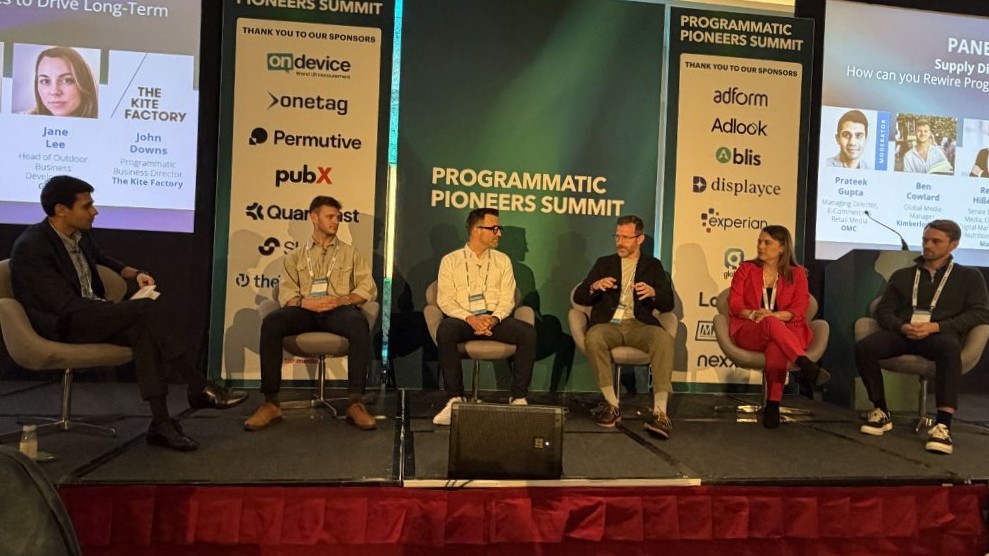
A panel at Programmatic Pioneers, at which RMA sister publication New Digital Age was lead media partner, brought together senior figures from across the media and advertising ecosystem to tackle one of the industry’s most persistent problems: how to break down silos, diversify supply, and build retail media strategies that go beyond short-term conversion.
Moderated by Prateek Gupta, MD of Ecommerce and Retail Media at OMC, the panel featured Ben Cowlard, Global Media Manager at Kimberly Clark; René Hißerich, Senior Director of Media, Content and Digital Marketing for Pet Nutrition Europe at Mars; Stephen Edwards, Head of Agency at Tesco Media; Jane Lee, Head of Outdoor Business development at Global; and John Downs, Programmatic Business Director at The Kite Factory.
Breaking down silos: it starts with the room
OMC’s Gupta opened by framing the central challenge: the industry continues to talk about unified planning across channels but execution remains fractured. He asked panellists how they were bringing retail media, digital out of home, paid social, and search together in practice.
For Jane Lee, the structural reality of programmatic out of home (OOH) is both promising and complicated.
“We know we’re part of this big strategy, but we don’t always hear about it,” she said, pointing to the persistent problem of teams managing different parts of a plan without talking to each other at the end point. Global has responded by creating teams that handle both its audio and outdoor estate simultaneously, enabling genuinely omnichannel planning.
She cited a live campaign that was running across digital 6-sheets (a portrait-oriented OOH format) and audio, a combination only possible because planning and programmatic teams were communicating throughout.
Stephen Edwards offered a more organisational diagnosis.
“This is going to sound really simple and really obvious, which is why it is really difficult to do,” he said. “It’s about establishing who the right stakeholders are, putting them in the room at the same time, leaving egos at the door, and often being responsible for figuring out what jobs need to be done.”
He described Tesco Media’s approach of creating forums where people who had historically never spoken to each other were brought together, connected by customer insight, and then tasked with deciding who does what. Alongside that organisational effort, he said, Tesco relies on long-standing data relationships with broadcasters, social platforms, and DSPs to execute audiences across a wide variety of supply types with a common underlying data architecture.
For René Hißerich, the complexity at Mars is compounded by geography. “Two years ago we created a dedicated regional media team, which was very new back then,” he said. That team, covering Europe, has spent the past two years making integrated channel planning business as usual.
But even with that progress, he acknowledged the tension between building a regional retail media framework and the fundamentally-local nature of the channel.
Moving retail media beyond ROAS
The second major theme was the industry’s over-reliance on return on ad spend as the primary metric for retail media, and how to shift client and internal expectations toward longer-term brand measures.
Hißerich said the answer at Mars was aligning KPIs across every part of the system. “The key for us is to have a set of aligned KPIs to make sure everyone is working against the same set of priorities,” he said. That includes commercial partners, agency models, and retailers, all working from a shared framework rather than optimising for different short-term outcomes.
Edwards pushed back against the idea of abandoning ROAS entirely, framing it instead as a question of understanding what role retail media should play at different points in the funnel.
Tesco’s approach is to evaluate media’s contribution to shifting behaviour in the immediate basket, while separately evaluating how channels and data shift behaviour and perception in future baskets. That dual view is supported by a range of tools, from incrementality studies to survey-based programmes across large customer samples, geo testing, holdouts, and creative AB testing.
Edwards said the bigger challenge is standardising that measurement across different retailers, and that Tesco’s focus is first on getting its own house in order before working with technology partners on broader standardisation.
Lee said Global had faced a similar challenge when retail media began growing rapidly.
“The first instinct was: ‘How do we combat retail media?'” she said. “Within a very short period of time we changed our position to: ‘How do we complement it and work with it?'” She argued that out of home’s strength in the consideration phase, what she termed the ‘messy middle’, made it a natural partner to retail media’s conversion focus, and that building buying plans around that complementarity was a more productive approach than competing for the same budgets.
What agencies need to do differently
The panel spent significant time on the role of agencies in bridging the gap between brands, retailers, and media owners. Gupta pushed panellists to say what the agency community needs to do better.
John Downs said the tools available had evolved more than the expectation. “I wouldn’t say the expectation has changed too much,” he said. “We’ve always prided ourselves on being strategic thinkers rather than just buying media.”
What has changed is the ability to execute on that ambition, with platforms offering self-serve omnichannel buying, and analytics teams able to run media mix models across all channels. He also described AI-enabled tools that can build site lists and curated audience lists from contextual prompts, making campaign planning faster and more precise.
Edwards said the value of agencies lies in their ability to connect different worlds within a brand or retailer’s organisation.
“Agencies really understand well how to connect those thoughts between the worlds of trade and the worlds of shopper and the worlds of media,” he said. But he also issued a challenge: too many people within agencies still treat retail media as optional, or as someone else’s job.
He described major programmes Tesco is running to engage agency communities across strategy, data, measurement, and planning roles, to ensure they understand how retail data should be integrated into long-term planning.
Hißerich echoed the sentiment, framing the agency relationship as one that needs to improve on both sides. “I see the agency as a critical partner of the team, but both clients and agencies need to step up.”
Lee added that education is at least as important as structural change. “As a media owner I’ve been putting on events, studies, lunches, and learn sessions,” she said. “I encourage you to get your teams to come. We genuinely want to share what we’ve got with you.”
AI, discovery, and what comes next
Gupta closed the panel by turning to artificial intelligence, observing that discovery behaviour had already shifted, with consumers increasingly finding products through tools like ChatGPT and Gemini rather than traditional search.
Edwards described three areas where Tesco is actively thinking about AI’s impact. First, on in-store discovery, he said there is growing evidence that AI is informing decisions before and during store visits, and Tesco is actively talking to clients about how to ensure brands remain discoverable in a world where AI recommendations are often a single brand rather than a selection.
Second, on ecommerce, he revealed that Tesco is testing an AI shopping system with around 300,000 users inside its app, designed to encourage healthier decisions, reduce food waste, and personalise recommendations using Clubcard data. Third, on the media business itself, he pointed to AI’s potential to automate creative production.
“We are producing over 7,000 pieces of content just for retail environments every year,” he said. “AI is absolutely perfect to automate this.”
Hißerich said the industry is still in an exploration phase when it comes to understanding how LLMs build their recommendations and what triggers them. “I think we need to understand what elements are removed and how they are triggered to make those recommendations,” he said. “This is the next step for us to explore together as an industry.”
Lee drew on research from Co-op’s participation in an earlier panel at the event, where the point was made that for some categories the audience is essentially everyone, meaning audience targeting is less relevant than planning to mission.
“People are often on a mission to do something,” she said. “If you can really leverage the power of that context, you can be part of that.” She said OOH’s ability to reach people in that active, purposeful state, combined with insights from AI tools and retail data, represents a genuinely exciting opportunity.
Downs, described AI-powered creative assessment tools that use eye-tracking technology and survey-based data to predict how effective ads will be before a campaign launches, across video, statics, social, and out of home. “Creative will be absolutely crucial,” he said, “even more so when you’re trying to reach people at the top of the funnel and generate intent.”
The ‘magic wand’ question
Gupta closed with a rapid-fire round, asking each panellist what they would change about retail media if they had a magic wand.
Hißerich said he would focus on measurement first, and then on integrating retail media into upfront planning conversations rather than treating it as a bolt-on.
Edwards said the biggest untapped opportunity was in creative. “The way we use data in retail media targeting is really smart and advanced,” he said. “The way we use data for creative still feels early. There is a massive opportunity to personalise retail-specific creative and test and learn in that environment.”
Lee said she would want to see more integrated retail media and programmatic out of home partnerships working together.
Downs said he would make all linear TV buyable programmatically. “It’s the last remaining silo barrier,” he said.
Gupta closed with his own wish: best-in-class collaboration that connects media owners, retailers, brands, and agencies in real time, enabling connected planning and execution beyond existing tools.