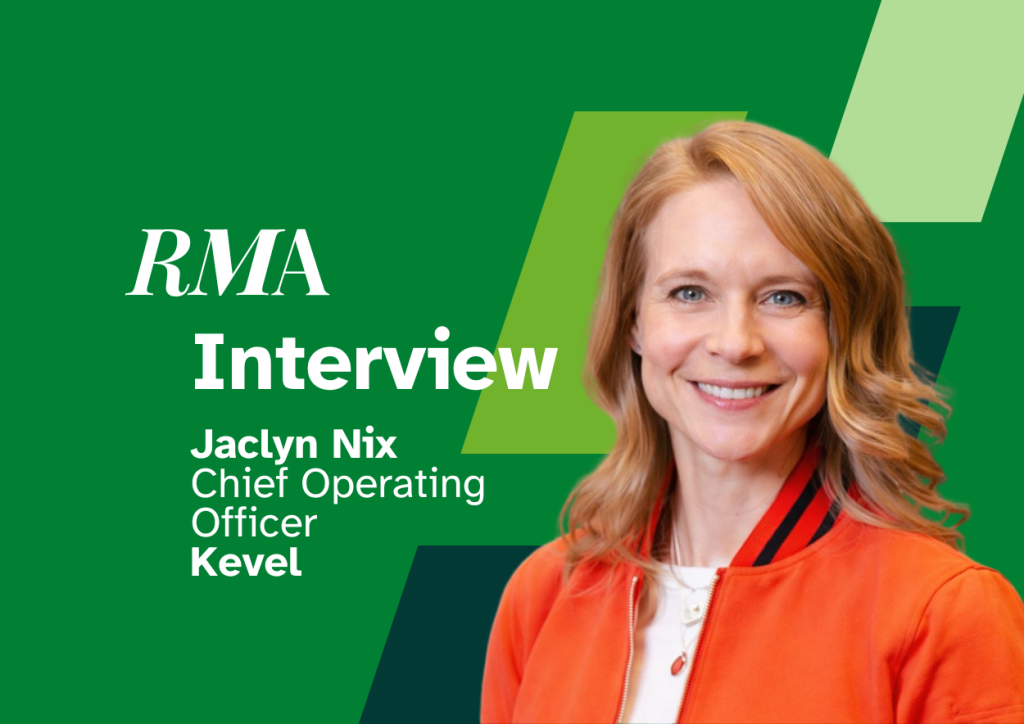
Earlier this month, retail media technology provider Kevel announced the appointment of Jaclyn Nix as Chief Operating Officer. Her appointment comes at a pivotal time for Kevel, as the company focuses on rapid expansion and scaling business operations in line with market demand.
Retail Media Age spoke with Nix to find out more…
Tell me about your new role – what attracted you to it and what sort of thing will take up your time?
What attracted me to the COO role at Kevel is the opportunity to help scale a company that’s fundamentally changing how retail media is built and operated. Kevel gives retailers and marketplaces true ownership of their technology, their data, and ultimately their growth strategy. That’s incredibly compelling given where the industry is headed.
Day to day, my focus is on operational excellence and scale: aligning teams across product, go-to-market, and customer success. A big part of my role is also staying very close to customers and partners, making sure we’re solving real market problems and helping them unlock measurable, incremental value.
What sort of support are brand marketers looking for in relation to Retail Media right now?
Brand marketers are no longer asking whether retail media works – they’re asking how well it works, and why. Support today needs to reflect that increased scrutiny.
First, brands are prioritizing strategic partnerships over sheer scale. With hundreds of retail media networks globally, marketers are focusing on fewer partners who can deliver consistency, interoperability, and measurable impact across onsite, offsite, and physical environments.
Second, transparency and control have become non-negotiable. Brands want to understand how first-party data is activated, how AI is influencing outcomes, and how performance is measured. Not just the result, but the drivers behind it.
There’s also growing demand for omnichannel creativity and experiences. Retail media is evolving beyond placements into storytelling with creative becoming a measurable lever for growth, not just an input.
Finally, brands expect smarter targeting, dynamic personalization, closed-loop measurement, and clear proof of incrementality. Every dollar is being scrutinized, and retail media must demonstrate how it’s driving tangible outcomes that wouldn’t have happened otherwise.
Has the Retail Media marketplace evolved faster than you expected?
The pace of adoption and spend has definitely exceeded expectations. Retail media has moved very quickly from test budgets to core line items.
What’s been more surprising is how quickly that growth has forced the industry to confront its limitations. Fragmentation, inconsistent standards, and uneven measurement maturity are now holding back the next phase of growth. In many ways, retail media hasn’t just grown…it’s grown up. The next chapter isn’t about launching more networks, but about operational maturity, standardization, and execution at scale.
What sort of innovations do you expect to see in the near future?
The next wave of innovation will be less about novelty and more about making retail media scalable and sustainable.
We’ll see greater standardization around measurement, reporting, and definitions of success, which will allow brands to compare performance and allocate budgets with confidence. Measurement will move beyond basic attribution toward true incrementality as a baseline requirement.
AI will also shift from a buzzword to a backbone, powering campaign planning, creative testing, forecasting, and optimization in real time. But critically, demand will move toward explainable AI. Brands and agencies will expect transparency into why outcomes occur, not just automated results.
At the same time, we’ll see a resurgence of creativity and storytelling, supported by data and closed-loop measurement. As omnichannel execution matures, creative will become a strategic asset that drives both performance and brand equity.
Does the buzz surrounding ‘agentic commerce’ threaten brand investment in Retail Media?
I don’t see agentic commerce as a threat; I see it as a forcing function.
As AI-driven agents influence discovery and decision-making, brands will need environments where they can still shape demand, deliver contextually rich experiences, and measure real outcomes. Retail media (anchored in first-party data and owned environments) becomes even more important in that world.
What will change is how retail media shows up. It will need to integrate seamlessly into new buying journeys, support personalization at scale, and deliver transparency in how decisions are made. Retailers that combine automation with control and explainability will be best positioned to attract brand investment as commerce becomes more agent-driven.
What key piece of advice would you offer brand marketers in relation to Retail Media for 2026?
Treat retail media as a strategic operating capability, not a tactical channel.
That means choosing partners who can prove incrementality, support creative experimentation, and offer transparency into data and AI, even if it feels harder in the short term. It also means investing in measurement frameworks that connect media exposure to real shopper behaviour, not just surface-level performance metrics.
The experimentation era is over. In 2026, the brands that win will be the ones that combine creativity, data, and technology into retail media strategies that are measurable, scalable, and meaningful.