Retail media has been growing rapidly over the past few years, as an increasing number of brands and retailers realise the potential it offers. Simultaneously, and seemingly unrelatedly, TikTok has continued to grow from strength-to-strength. Now, as more money is funnelled into both, their paths may be on track to converge.
That’s the opinion of Colin Lewis, retail media expert, Director at Retail MediaWorks, and Editor-in-Chief for Retail Media at Internet Retailing, who believes the “TikTokification” of content and commerce is set to reshape the future of retail media.
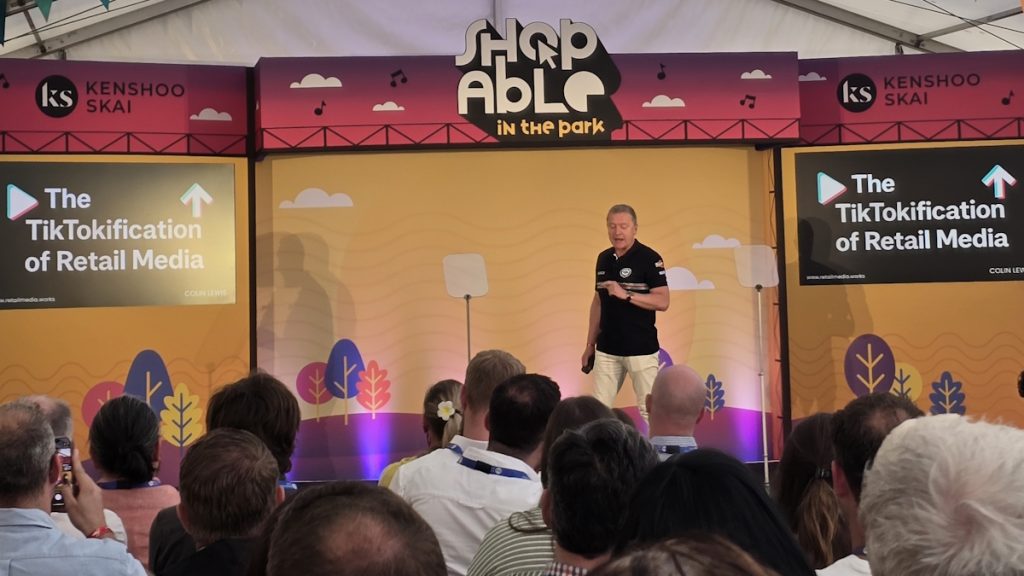
“Video is super impactful. It’s like a demand engine for us. It can help us tap into that. And the quality of the screens, the quality of 5G, is the trigger behind a lot of this, because we weren’t able to do this five or 10 years ago,” said Lewis, speaking at Kenshoo Skai’s ShopAble in the Park event.
“TikTok itself is this video thing that unites discovery and conversion all at once, and it’s a new dynamic that hasn’t really existed before, because this discovery and conversion always had a gap.”
Influencing the advertising ecosystem
At the heart of TikTok’s influence on retail media, according to Lewis, will be the role of influencers and content creators, who have now become a “medium” in themselves.
He presented the example of one of his clients in Turkey that is selling influencers within their overall media strategy, having events where they sell to suppliers with influencers there in-person.
“You might say, ‘Colin, it’s a bit tricky to take creator or influencer inventory and put it over here under the retail media business.’ And, I say to you, you’re wrong,” said Lewis.
“Watch for a lot more of that sort of creative thinking about how we get influencers, how we package them, and then how we sell as part of our retail media inventory.”
This is something that, Lewis says, is also already a big part of the way Chinese advertising works in general, and it’s suggested that brands can’t break into the Chinese market without influencers. Even farmers within the world’s second most populous country are broadcasting live and selling their goods direct-to-consumer.
“Everything they’re doing is what we call retail media. They just call it advertising. Because all advertising is digital, and it’s all powered by keyword searches, display, and so on. They were doing it five years ago,” said Lewis.
“We’ve already seen the future. We know where it’s going, because we’ve already seen it happen in China.”
Bringing social to the store
The revitalisation of the home shopping network via social media platforms like TikTok can also be used to fuel in-store experiences, according to Lewis.
In particular, in-store screens can be leveraged to amplify social content further, and ensure that creator inventory is able to reach consumers at every touchpoint.
“These screens are incredibly high-definition, and lots of different sizes,” explained Lewis. “So, why not take the thing you’re doing over here on TikTok with your creators and package it, and then make it appear in this other channel which is actually on the store screens? And imagine having the impact of this screen in-store or in-window.”
This all ties into not just the “TikTokification” of retail media, but a transformation of retail in general.
“Short-form video compresses the time between inspiration and transaction,” said Lewis. “What are you doing on short-form video as part of your retail media business? How are you integrating it? How are you pricing it? And how are you putting it in as an inventory?
“[Quoting a client] ‘The evolution of retail is to become more social… Conversion everywhere.’ Conversion can happen through the retailer, through Amazon, they don’t care where it happens. They just see the world through this lens of conversion everywhere,” Lewis continued.
“Social-first. Vertical video. Creators. Shoppable media. Conversion everywhere. That’s what the TikTokification of retail media is.”