Retail media offers brands an opportunity to be visible in front of shoppers who are close to the point of purchase: one that goes beyond what other channels can provide.
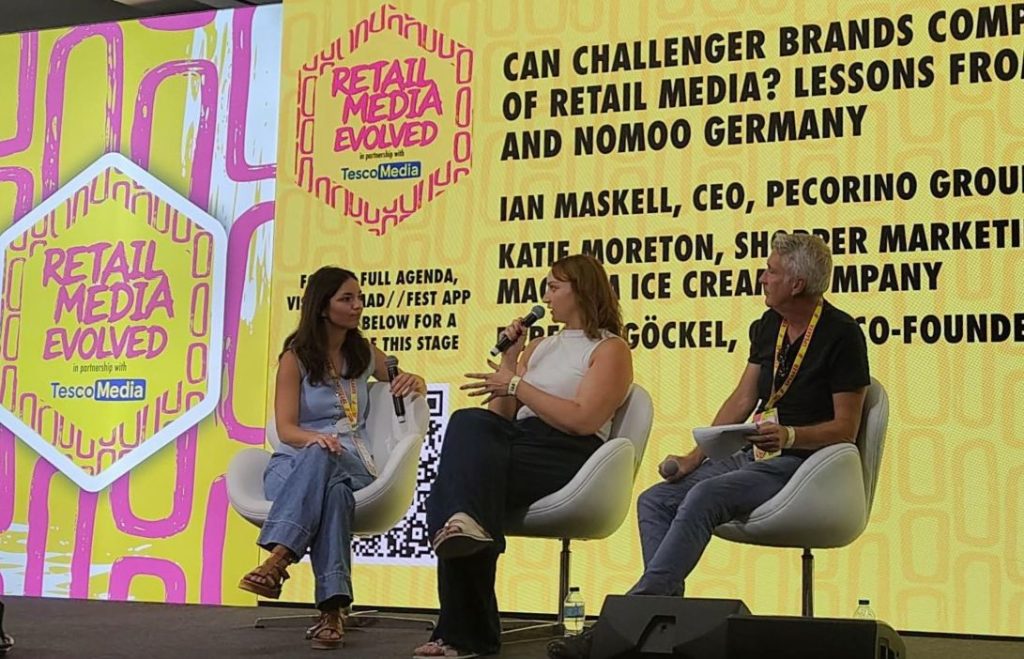
But does this opportunity benefit established brands and smaller challengers alike? This was the question posed by Ian Maskell, CEO of Pecorino Group, during a fireside discussion on MAD//Fest London’s Retail Media Evolved stage.
Maskell was joined by leaders from two very different CPG brands – at least, different in scale, although both are in the business of ice cream. Katie Moreton, Shopper Marketing Director at The Magnum Ice Cream Company, represented an established British brand with considerable resources and spend; while Rebecca Göckel, CEO & co-founder at dairy-free ice cream brand Nomoo, came from an upstart challenger brand operating in the German market.
The two broke down the strengths and shortcomings of retail media for their respective brands and considered how to get the most out of retail media whether you’re a major legacy brand or a nimbler challenger.
Retail media is the “fuel” for brand demand
Both Moreton and Göckel made the point early on that retail media is only able to deliver on the demand that has already been generated by brand-building activity. “In isolation, it’s not the be-all and end-all to support retail media,” Moreton said. “A lot of the hard work on a brand like Magnum, or Solero, or Ben and Jerry’s is done upstream in the brand-building.
“It definitely is a tool that we use to help support and convert that demand [that has already been created], but it’s not the only lever that we pull.”
Göckel echoed this as she talked about the benefits of being close to the consumer as a challenger brand: “First of all, I must know how to earn the attention of the consumer, how I can add value for the consumer – and afterwards, I can scale that with retail media.
“So, for me, retail media is just the fuel. You need to have the proper engine; retail media can scale demand, but it cannot create it.”
Given the sheer weight of brands like Magnum that are household names in many of their markets, it can be argued that they have a clear advantage in this regard. Challenger brands have to work much harder to cut through the noise – and to build up the kind of brand recognition that their bigger competitors already enjoy.
Moreton acknowledged that there are distinct benefits to being an established brand and ‘category champion’ that aid the relationship with retailers. However, she pointed out that challenger brands have their own leverage:
“If you can demonstrate that you’ve created that demand, you’ve got a product and an innovation that’s perfectly set up to work in a retailer – retailers want to support brands like that who are going to get customers across the road and into their stores.
“So, I don’t think it’s an either-or.”
The cut-through power of creative
Historically, creative hasn’t received a great deal of emphasis in retail media. In large part, this is due to its perception as a bottom of the funnel touchpoint: one that doesn’t need to do a lot of heavy lifting in terms of brand building and storytelling.
However, this is beginning to shift, as evidenced by the fact that multiple discussions on the retail media stage focused on the importance of creative.
Moreton put forward that successful retail media needs to blend both creative and pure ‘media power’: “Investment into retail media without that creative thinking, and positioning the product as the perfect solution for the occasion – that’s never going to convert at shelf.
“…What’s also really important is building the distinctive assets for your brand. It’s becoming quite cluttered in store, and that distinctive cut through – if it’s linked to the brand building that’s done before somebody gets to the shelf – that’s what will set you apart.”
Göckel added that if she were given unlimited spend, she would allocate the bulk of it towards memorable and creative brand experiences. She gave the example of a LinkedIn post that had been particularly impactful for Nomoo, in which the team used generative AI to create a newspaper front page splash that depicted people queuing up to try the brand’s new ice cream.
“I think you have to be remembered for something,” she reflected.
Moreton also argued that retail media is increasingly developing into a tool that can build brand as well as capitalise on demand. “We can now do things like some really exciting experiential in-store [campaigns] that are closer to the point of purchase; so, you’re building both the brand and the brand love, but also driving that conversion.”
Who has the data?
In the UK, Moreton pointed out that industry players have invested considerable resource into developing technology and measurement, while many retailers have also built out sophisticated loyalty schemes, prioritising the targeting and revenue opportunities offered by this data.
All of this means that advertisers have a wealth of data available for granular targeting, something that she argued benefits challenger brands as well as established players. “It’s super useful to be able to know that you’re targeting a relevant audience with the retail media data that we’re getting back.”
“I would love to have that data,” Göckel responded, “but as a challenger brand, most of the time, it’s just too expensive to have it.
“So, I’m always talking to consumers and learning from them in lieu of buying the data from retailers.”
The two agreed that this was something of a disparity between the German and UK markets, but Moreton also highlighted challenger brands’ focus on their category and their consumer as a significant strength.
“Being able to find out how your shopper is consuming your product; why they love your product so much; being real experts within a category – that helps with all decision-making and it means that you can put the consumer at the heart of everything you’re doing.”
How established brands and challengers alike can win with retail media
“Challenger brands always think they have a budget problem, but really they have an attention problem – or a focus problem,” Göckel said when asked to name the mistake that challenger brands most commonly make in retail media.
“My advice is: check every channel, test every channel, understand your consumer and know how you add value to their life – and then double down on one channel, one message. Learn first how you earn attention, and then after that, you can scale it with retail media.”
She added that it’s not possible to “out-budget” established brands – but challengers can “out-understand” them with their finely-honed knowledge of the consumer.
Moreton made the point that the brands who win over the next five years will be the ones who lean into the evolution currently taking place within technology without losing sight of creativity.
“Get close to the consumer – and make sure that you’re landing the right message,” she said.
Read more of Retail Media Age’s coverage from Madfest London 2026.