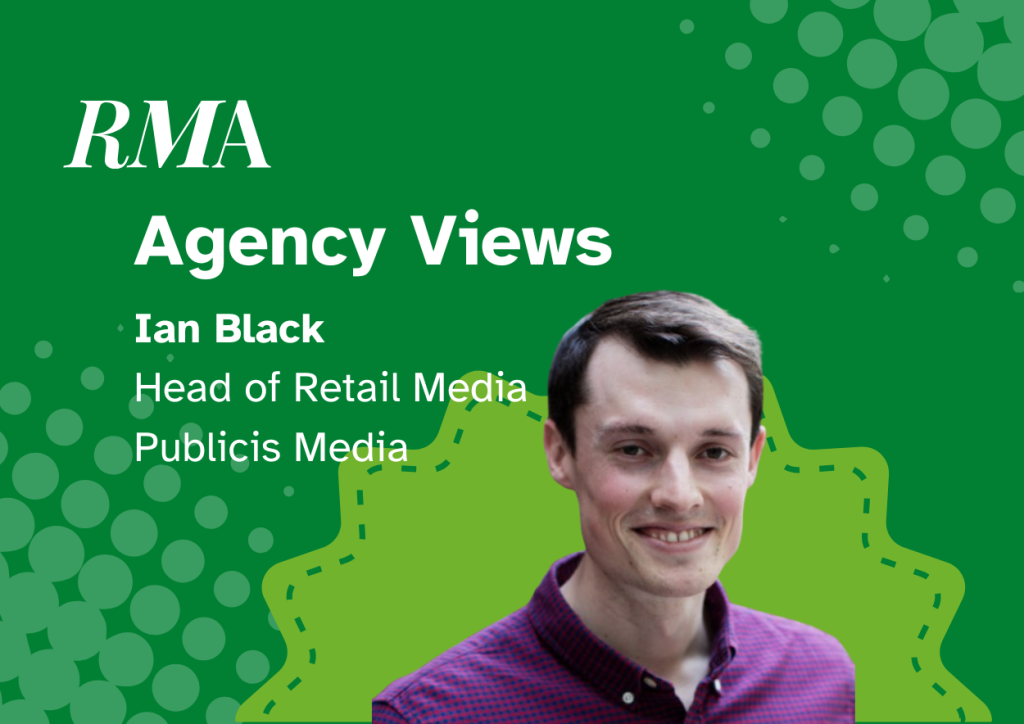
‘Agency Views’ is a brand new interview series from Retail Media Age exploring the agency viewpoint on retail media. Our first featured interviewee is Ian Black, Head of Retail Media at Publicis Media.
He talks about how Publicis Media has evolved its proposition in response to the rise of retail media, why he’d love to debunk the myth that retail media only serves the bottom of the funnel, and his advice to any brands who are considering retail media as part of their channel mix.
What has the rise of retail media been like for Publicis? Have you evolved your proposition or your pitches to clients in response to it?
For Publicis Media, retail media has shifted from a specialist add-on to a core, connected capability.
We’ve built a Retail Media Centre of Excellence within Publicis Commerce, bringing strategy, activation and measurement together end-to-end rather than in silos.
We’ve also scaled capability through acquisitions and proprietary tech, connecting onsite and offsite media, retailer data and commerce intelligence to help clients navigate a disconnected landscape.
It’s important to understand that we treat retail media as a business transformation agenda, not just a channel. Through initiatives like our Commerce Academy, we’re helping teams connect retail media to wider brand and customer strategy. This programme has upskilled more than 1,000 Publicis UK employees across key aspects of commerce and retail media.
How are you seeing client strategies evolve around retail media?
Strategies are becoming more connected, selective and outcome-driven.
Clients are aligning brand, trade and customer objectives to reflect how people actually shop, rather than internal silos. Our How Shoppers Shop research shows 1 in 3 shoppers switch brands in the aisle after using their phone, highlighting how discovery and decision-making are now happening in the same moment.
Investment is also becoming more forensic, with greater scrutiny on retailer capability, data access and product maturity.
Measurement expectations are shifting beyond ROAS towards incrementality, new-to-brand customers and retention, with retail media expected to drive broader growth. To this end, we’ve built proprietary technology such as Publicis Warehouse, which allows for our clients to connect their media tactics with bottom-line measurement such as product level profitability and media-derived sales percentage.
There’s also a move towards understanding impact across multiple retailers, rather than optimising in isolation. Identity is key here, helping create a more unified view of the customer. Our identity framework, Publicis Connected Identity, underpins this by linking retailer signals with wider media and consumer data to plan against real customer journeys.
Social commerce is now part of the mix too, with platforms like TikTok Shop acting as both sales channels and demand signals for retail media planning. Through our partnership with ASDA in support of their Tickled Pink campaign, we recently launched an exclusive TikTok Shop bundle featuring custom pink adapted SKUs from 9 iconic household brands. This campaign reached 9.7M people and sold out in just 4 days, highlighting the power of social channels as both sales and demand drivers, even for retailers.
Read more: Editor’s View: On AI-influenced discovery and being present across the funnel
What is your approach to dealing with any silos on the client’s side?
We start with a commerce diagnostic to map goals, budgets, teams and measurement, identifying gaps and quick wins, then design a simpler, more connected way of working.
We bring media, sales and commerce teams together, because retail media only works when it reflects both retailer realities and media effectiveness.
Where clients have strict ownership structures, we work within them but challenge where they limit a connected plan.
What do you think is the key thing that sets retail media apart from other channels or media types?
Retail media combines three powerful elements: consent, intent and measurement.
Retailers have strong first-party relationships built on clear value exchange, giving high-quality, consented data. They also see real shopping behaviour across categories, creating rich intent signals that become even more valuable when connected through identity frameworks.
Finally, the ability to link exposure to purchase enables closed-loop measurement. The opportunity is using that not just for short-term optimisation, but to understand contribution to longer-term growth.
What’s a common misconception about retail media that you’d love to debunk?
That it’s only a lower-funnel channel.
Retail media can influence people at multiple points in their decision-making journey when planned around audiences and shopping missions, not just products.
It’s also not just a media channel: it sits across media, merchandising and customer experience, so success depends on retail fundamentals as much as activation.
Not all networks are equally mature, so brands need to separate promise from proof.
And there’s value beyond endemic opportunities, with non-endemic retailers offering powerful data and reach that can still drive broader growth. A great example of this was our work with Vauxhall and Tesco Media in which we developed a non-endemic strategy involving sponsorship of EV charging points, car park screens, on-site placements, off-site data usage and a unique Clubcard reward mechanic. This campaign built on the natural brand synergy between Tesco and Vauxhall and was effective in driving demand for their new Corsa EV range.
What one piece of advice would you give to brands who are considering adding retail media to their channel mix?
Start with measurement.
Define the role retail media plays in your growth strategy, test for incrementality, and scale what proves real value rather than relying on proxy metrics like ROAS.
Treat retail media as an ecosystem of different retailer networks, each with a distinct role, rather than a single channel. And use identity to connect it all.