Good morning from Retail Media Age HQ,
Just a few weeks ago, I asked the question of whether standardisation can solve retail media’s fragmentation woes, off the back of multiple reports and initiatives that set out to create standards in an industry that many believe would benefit from being more joined up.
The US Association of National Advertisers, or ANA, published a report that aimed to “establish an initial framework to help drive outcome comparability” in retail media, while a survey conducted by the Latin American brand of Marketing + Media Alliance found that 43% of marketing and advertising professionals see the absence of standardised metrics as retail media’s main problem, with many advertisers coalescing around major players as a result.
This column feels like a spiritual Part Two to that piece. More steps have been taken in recent weeks by industry bodies to establish shared practices for retail media capabilities, which have appeared against a backdrop of commentary about the need for transparency and verification as retail media grows.
Earlier this month, for instance, ISBA partnered with mediasense to release the second half of its landmark Digital Retail Media Study, using more than 200 capability data points to establish an industry baseline for retail media.
Writing for Retail Media Age on the study’s findings, Clare O’Brien, Associate Media Advisor at ISBA, commented that, “The principal finding of the report is an unambiguous and immediate need to address the very basic lack of fundamental shared definitions of what the digital retail media offer is from each RMN. In essence, it’s a language issue; we are not currently working with a shared glossary.
“The reason this is so important – for both the RMNs and the brand advertisers – is that its absence is making this extraordinary digital advertising channel unaffordable for brands to invest in at scale. It’s a fragmented opportunity that is becoming difficult for marketers to invest in by building the correct teams and channels to operationalise – internally and with their agencies.”
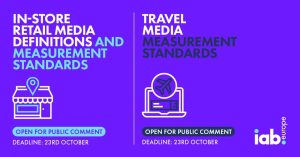
Then, last week, IAB Europe put forward two new commerce media measurement standards documents for industry comment: one proposing next steps for in-store retail media measurement and the other setting out a travel-specific addendum to its Commerce Media Measurement Standards.
In the case of IAB Europe, the industry body already has measurement standards for commerce media that have been in place since April 2024. But there is still evidently a challenge in making sure that they meet the various requirements of the industry and that they evolve fast enough to keep pace with retail media’s rapid development: the standards were revised in January 2026 following a three-month public comment period and are now receiving an addendum around travel.
Meanwhile, some industry comment has alluded to a backlash against retail media over a perceived lack of transparency or quantifiable results – with The Grocer publishing a piece in July titled, ‘Why retail media is facing a backlash’ that quoted one pseudonymous supplier as saying that “many suppliers privately regard retail media as a dressed-up listing fee” and described a general pressure to buy into retail media perhaps despite discomfort.
The Drum’s podcast ‘The Basket Case’ also recently tackled the subject of retail media “marking its own homework” and possibly cherry-picking methodologies that present performance in a better light, with Assistant Editor of Branded Content Maria Greaves writing that, “Retailers want to demonstrate that their media is working, so naturally have an interest in choosing methodologies that present performance in the strongest possible light.”
Ultimately, guest Elizabeth Donovan, EVP, Head of Commerce & Retail Media Networks at Axciom Omnicom, determined that “Universal standards are a must.”
I do think that this isn’t solely a standards or measurement issue, since a lot of the confidence problem around retail media could be addressed with better education: how retail media works, what sets it apart from other channels, why it’s effective and worth buying into.
Absent that perspective, it’s not too surprising that advertisers might be confused about the hype or experience it as a pressure to buy into something without a thorough grounding on the reasons why.
But better shared standards and more openness can also help to build that confidence by showing that retail media is interested in, to run with the analogy, having its homework marked by the teacher (or publishing its marks at least?) and creating the consistency that will allow for scale, maturity, and greater buy-in as well as a perception of real value and not just excessive hype.
Read more viewpoints from Retail Media Age’s editorial staff and expert commentators in our RMA columns.