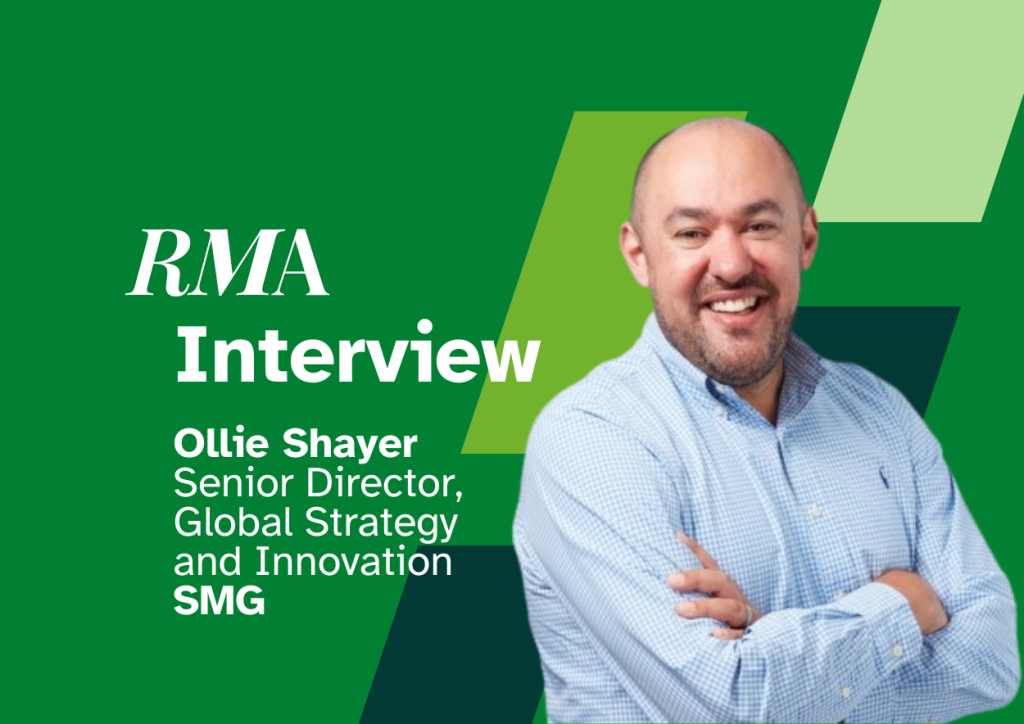
Connected commerce group SMG recently went live with a major new proposition: a Commerce Media Network (CMN) Maturity Index.
Speaking at Day 1 of Advertising Week Europe, Ollie Shayer, Senior Director, Global Strategy and Innovation, explained that with the explosion of growth in commerce media and huge number of new entrants to the space, brands are increasingly faced with decisions about who they should work with – and commerce media networks want to better understand how to stand out in such a competitive space.
“It’s about providing a framework and structure that we’re seeing, increasingly, will help commerce media networks make that decision [about how to be successful in the future],” Shayer told Advertising Week’s Katie Ingram.
“We’ve taken data across the industry to look at: Where is the market currently? And where will it be by 2030? And therefore, what do you need to have ready to be able to do that?”
He added that the “what” of commerce media networks’ propositions – their basic composition – has become table stakes, but the “how” is more complex: how CMNs measure, how insightful they can be with the data that they have, and whether the proposition is a core part of their business.
I sat down with Ollie Shayer after his talk to get more insights into how SMG’s Maturity Index came to be, some of the challenges involved in bringing those metrics together, and what’s next following the launch of the Index.
What was it that led you to launch the Commerce Media Network Maturity Index?
Increasingly, people have been asking me – “What should the future of my commerce media network look like?”
When I looked at that, and the way in which the market’s evolved, it made me think: a core area of growth is not only about the offer today – it’s about how it grows in the future.
Because of the nature of what’s needed, not only in what you need to develop as a product channel, but equally how you set yourself up, and also how that’s integrated into the core business – it’s not instantaneously turned on. It needs a structure around it to help.
The other factor was: each commerce media network is different. There’s not a one-size-fits-all solution – you may decide to over-focus on one area versus another. Logic would say, ‘I want to be great at everything’ – but you might have fantastic data that allows you to have even stronger insight than your competition, and that allows you to differentiate versus someone else.
It was also a question that I constantly asked myself in my last role [as Omni-Media Director at Boots UK]: “What do I need to be better than the competition?”
How do you envisage CMNs making use of the Index?
We use it already for the consultative services that we offer; we work with commerce media networks to understand where they are today. We’ve plotted out against the US, UK, and European markets – and we’re able to benchmark holistically where most of the market is against the 126 points that we’ve got.
Then, we can play back to them – “This is where you are today. These are the strengths you have as a business; and this is therefore where you should be focusing your energies going forward.”
Effectively, it allows you to diagnose where you are today, look at where the market is, and then understand what you need to have to enable you to grow.
More critically, you have to have a view of what you want your proposition to be. So, once you diagnose it, we then do a secondary part, which is more around, “What is it I want to be?” Which also helps to guide you towards where you want to go.
You’ve got different regional markets encompassed in the Index: is there a challenge involved in reconciling the differences between those market characteristics? How do you assess maturity for a global CMN that operates across multiple markets?
There are consistencies between markets – there are probably greater variances in things like the digital focus in the US, versus more of an omnichannel focus in the UK. The “what” – which is the channel mix you utilise, what’s important to deliver the media choice – you see some variances there.
We have data by market; we can assess what the benchmark by market would be, and then look at it in that way. The core consistency is: there are themes that are wholly consistent across global; things like measurement, insight, relationship management, how it sits within the organisation.
Increasingly, it’s converging: I’ve spent a lot of time in the US over the last year, and increasingly, their focus is on how they manifest the store environment. Which is something that we have already in the UK.
It’s really about helping to guide the right approach between each of those different markets – but the principles remain the same.
Are there any other challenges you’ve found in building the Index out and bringing it to market?
It’s a constantly-evolving market! The growth in commerce media networks has exploded, even more than we thought; but we’re taking the view out to 2030 as to where we think the market’s going – which helps inform us as to what we think will be important.
For us, this is a living, breathing thing that we’ll do constantly – and it’s built on 18 years of experience as a commerce media agency that we’ve got at SMG.
It’s looking back to what we’ve known has happened – but also allowing us to look forward, as well.
Where do you see the Index evolving, and what do you have planned next?
For us, there’s increasing interest in being able to set longer-term strategies for commerce media networks – because retailers and commerce partners want to have a clearer strategy going forward, and this is something to help with that.
What we’ve seen already is that there’s a real diversification in the markets – and I think the most mature partners are ones who have the capability across the “what”, the “how”, and the central elements together. Those are the ones you see growing.
Ultimately, it’s also about the mentality that people are bringing – to continuously want to be curious, to keep the product ready for the market. You can’t just set it and forget it.
We would recommend [benchmarking maturity] on an annualised basis – and then having it inform the roadmap going forward. There’s lots more to come – but I think we’re already seeing the benefits of it; and there’s more opportunities for us to use the data to help our partners and other partners we work with going forward.
Read more of Retail Media Age’s coverage from Advertising Week Europe.