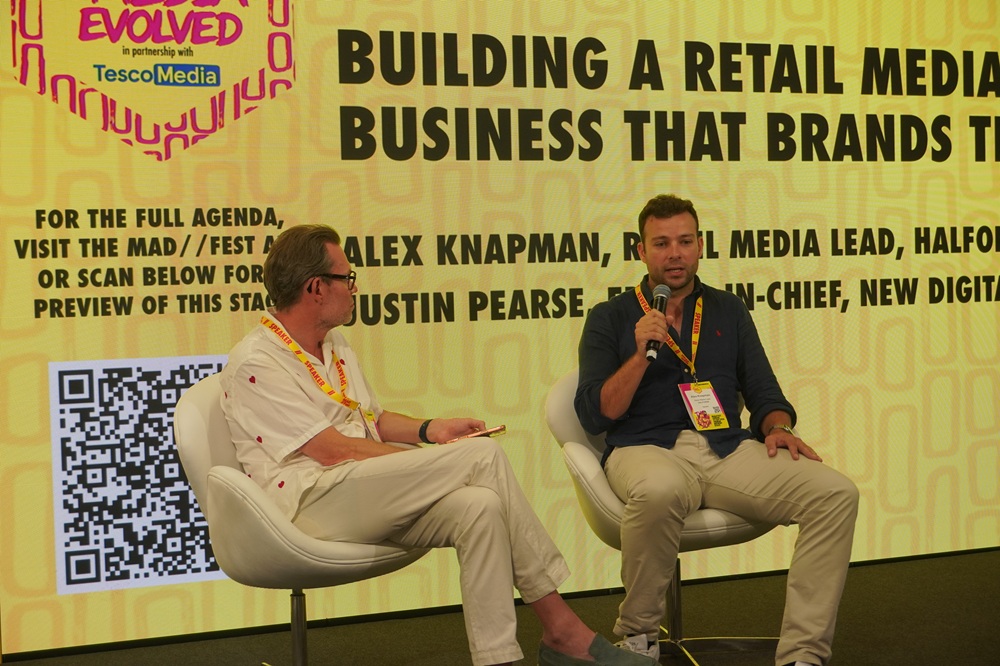
Alex Knapman leads retail media at Halfords, where he has spent the past eighteen months building an in-house function from scratch. Retail Media Age caught up with him in a fireside chat at MadFest to talk trust, creativity and the future of the channel.
How do you make Halfords’ retail media network different from the grocery giants?
Retail media is often framed as a grocery story, built around repeat baskets, FMCG relationships and the sheer granularity of the data. Halfords is different because it sits in a different vertical, spanning automotive, cycling and mobility.
Grocery moments tend to be routine, a weekly shop or a top up, whereas Halfords deals in big moments, an expensive repair bill, someone driving their first car, planning a holiday abroad or buying a first e-bike.
Those are emotional, high stakes occasions, and that is a powerful place for brands to play. Customers also place huge trust in Halfords, so when a brand buys into a campaign, it is borrowing some of that trust and expertise too.
That cuts both ways, which is why Halfords turns down briefs that are not the right fit for its customers.
When did the business realise retail media was worth serious investment?
The turning point was moving from something tactical to something scalable. Every retailer has had entrepreneurial people spot that its inventory has value, whether that is out of home screens in car parks or a loyalty offer traded for an email send.
The value was already there in pockets, scattered across different teams. The shift came from recognising that value, proving it out, and then bringing everything under one team with an overview of the whole picture, which ultimately delivers better outcomes for customers and advertisers alike.
What are the real pillars of trust in retail media, beyond clean rooms and closed measurement?
Clean rooms and transparent data both matter, but trust is broader than that. It is cultural, an ethics and values question.
It comes down to whether a partner sounds like they know what they are talking about, whether you believe in what they stand for, and how you handle it when performance falls short of expectations. One of the pitfalls of business is optimising for quarterly or annual targets in ways that do not serve the long term relationship.
Sometimes that means turning down a brief because the campaign will not perform as the advertiser hopes, even though it would be easy to take the money. Running it anyway erodes trust and ultimately limits growth.
How do you help advertisers prove value to their CFO?
What marketing is worth and what marketing can be measured are not always the same thing. Return on ad spend is relatively easy to inflate by targeting people who would have bought the product anyway.
What is much harder, and more valuable, is proving incrementality among customers who buy the category but not the brand. That requires brand lift studies and more sophisticated metrics, and the industry is getting better at delivering them. Ultimately it is about helping clients show that a campaign has added value, not just chasing a headline ROAS number.
How do you balance advertising with customer experience in a trusted environment like Halfords?
It starts with understanding your positioning. A premium retailer needs to be far more careful about how ads show up than one known for being the cheapest in the market. Halfords sits closer to the cautious end, because customers trust it to keep them safe on the road.
Rather than monetising eyeballs, the focus is on creating moments and propositions that add value for both advertiser and consumer, such as how to videos on changing engine oil or fitting a car seat. The products shown may be sponsored, but the content itself is genuinely useful.
What about non-endemic brands, and the growing fragmentation of retail media?
Programmes like the Halfords Motoring Club, which offers MOT cover alongside checks and discounts, show how non-endemic partners such as Eurotunnel or ferry operators can add real value without feeling jarring, because they are relevant to what customers are already doing.
On fragmentation, recent moves such as Ocado’s partnership with Amazon and the Unlimited Alliance show retailers weighing up how much inventory to curate themselves versus joining a bigger network, much as retailers have long done with out of home advertising.
Can retail media build brands, not just drive sales?
Absolutely. Byron Sharp’s work at the Ehrenberg-Bass Institute shows that brands grow by building mental availability, how easily people recall them, and physical availability, how easily people can buy them.
Traditional channels are strong on the first, but retail media can do both at once. As stores become more digitised, with more screens and richer video content, brands can build awareness at the point of purchase itself, often with a sales uplift alongside it.