The summer (and late spring) period is always packed with events and industry get-togethers.
Between major calendar highlights like POSSIBLE, Cannes Lions, DMEXCO, and MAD//Fest and sector-focused events, there’s never any shortage of gatherings where members of the industry can put their brand propositions out there while learning from and connecting with others.
But with so many events to choose from, how should people make a call as to which events are most worth their time, either to attend and network or to have an organisational presence? How can companies make the most impact with events, and how should they measure the return? And is it just about big “tentpole” events or do smaller, curated gatherings have their strengths?
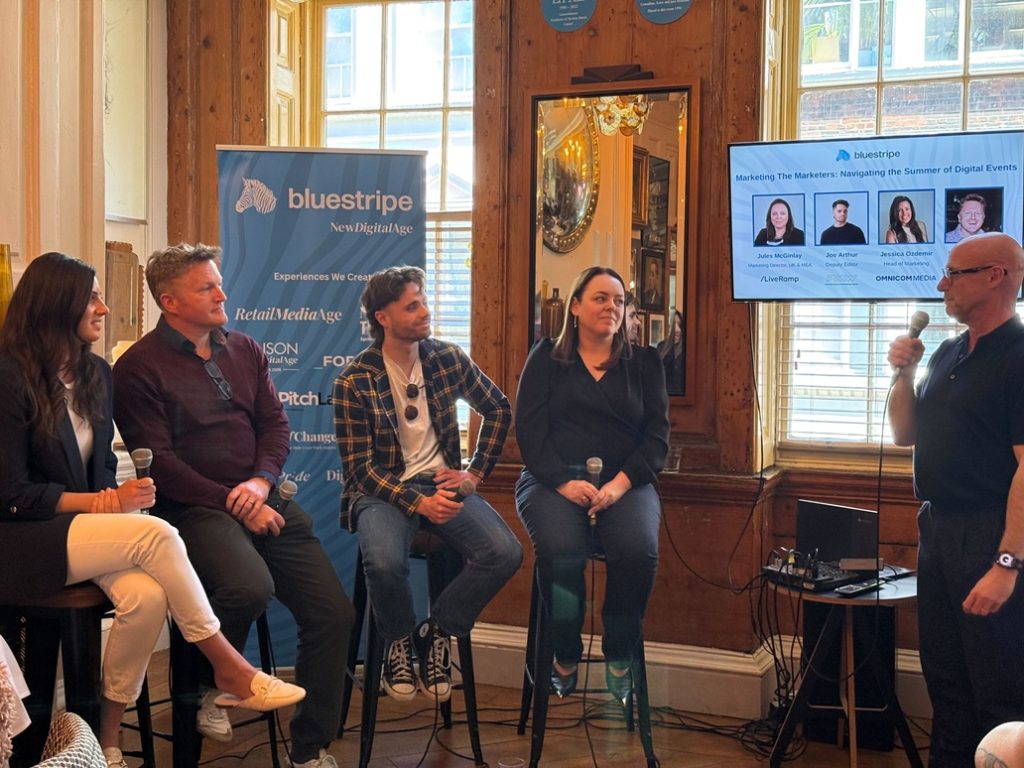
At Marketing the Marketers, hosted by Retail Media Age publisher Bluestripe Group, a panel of experts with different perspectives gave their insights into this question: Jules McGinlay, Marketing Director, UK and MEA at LiveRamp; Joe Arthur, Deputy Editor at Performance Marketing World; Jessica Ozdemir, Head of Marketing at Omnicom Media MENA; and Dominic Tillson, Founder and CEO at DST, with Bluestripe Group CEO and co-founder Andy Oakes moderating.
Go in with a plan – but don’t expect a definitive ROI
Multiple panellists spoke to the need to pre-plan and lay the groundwork prior to attending an event.
“You really need to be promoting brand messaging and relevant assets in the time leading up to an event, so that people arrive with a perception of you” said Jules McGinlay, noting that an event is not a strategy in and of itself.
She also highlighted the importance of building an experience that’s both central to the event and to your brand. LiveRamp specialises in data collaboration, and to highlight the platform’s AI capabilities, the team operated an AI photobooth at MAD//Fest where participants could get a printed image of themselves as a “data collaboration hero”, linking AI to the platform’s mission.
“You can very rarely say a meeting from one event led alone to a sale,” McGinlay said. “It has to be an integrated strategy before, during and after.”
When working with his previous organisation, Azerion, Dom Tillson recalled inviting ad agencies to play darts – which is popular in the Netherlands, where Azerion was based – and theming the activity around accuracy.
“The key thing is to be memorable – and have something that’s repeatable,” said Tillson, noting that Azerion then became known as the company with the darts.
He said that CFOs sometimes view events like ‘last-click attribution’, “whereas from my point of view, events are really about the upper-funnel – and it’s the people you work with who then do the conversions.
“Or you create conversations that after the event can turn into a performance activation and be measured.”
Are events like Cannes a must-attend?
Major expos like Cannes and MAD//Fest are staples in the diary and bring together a who’s who of the industry, which gives them a kind of gravity that makes them difficult to miss. However, moderator Andy Oakes put the question to everyone: do organisations still have to be at Cannes?
Jessica Ozdemir said that Cannes is “huge” for Omnicom, with “some of the most creative minds” in the industry in attendance, but she challenged the room to think about how to capture those who can’t make it to events like Cannes, as massive as they are.
Omnicom Media will create “snapshot” booklets to send to clients who couldn’t attend – or even those who could, but weren’t able to make it to everything they wanted to – with the event’s key themes. She drew links to Justin Bieber’s recent Coachella set and how he successfully played to the performance’s livestreams and fans watching online.
“The ability to tap into the in-person audience as well as those who are at home is key.”
PMW’s Joe Arthur argued that “Cannes is for connections; it’s not for content” – even speaking as someone who is there with a content hat on. He described Cannes as a great place for initial meetings and conversations that form the start of a longer relationship.
Editorially speaking, he said, readers are also interested in learning about those conversations taking place between sessions and in the evenings.
As a piece of advice for anyone looking to make more effective connections with press at major events, Arthur said, “There’s value in having conversations with the press there – but less news, and more, ‘What can you share with the broader audience that they’re going to find valuable?
“At a lot of these tentpole events, we’re producing [content] for everyone who couldn’t attend, and trying to capture a flavour of, ‘What was different this year to last year?’”
“I think you’ve got to go in two-footed if you’re going,” he concluded. “You’re up against an awful lot of competition there; but I think having feet on the ground is very important.”
The major event ‘halo effect’
Events like Cannes are such a draw that organisations can take advantage of this by running events that take place around the same time, because of how many industry players will already be around for the main get-together.
McGinlay explained that LiveRamp previously ran its flagship event, RampUp: Paris the week before Cannes: “You get a lot of senior people already planning to attend from all over the world… There can be advantages in terms of VIP guests and speakers in putting that together.”
Another important point on the value of events was made by Tillson, who encouraged people to flip their thinking on its head and consider the potential cost of not attending these big events. “If you’re not there, your clients are talking to your competitors – and it’s really as simple as that,” he said.
“We go [to events like Cannes] even if we don’t have a lot of new business meetings … We just spend time looking after our clients; as long as you’re there building personal relationships with people, it’s a great place to do it.”
Tentpole events versus curated gatherings: What works best?
It doesn’t just need to be about having (or not having) a presence at major tentpole events: organising your own event can be incredibly effective in bringing together a dedicated, focused audience for those presentations and conversations that events are so valuable for.
Tillson advised that hosting an annual event is useful because it creates a fixed point in the diary that people will then keep free in the future.
Ozdemir noted that based on Omnicom Media’s experience with hosting its own events, “The event itself represents 30% of the value – the other 70% comes from everything you do before and after it.
“What tactics can you deploy in the lead-up to the event? What can you do post an event?” Some examples include content teasers, countdowns on social media, and event follow-up snapshots for those who couldn’t attend.
“With owned events, you can control who you invite as speakers and shape the narrative much more closely; but there’s pressure that comes with that too.”
Arthur also put forward a strong argument for complementing your tentpole events strategy with smaller, more dedicated gatherings. “The smaller-scale roundtables; lunch and learns, pairing that alongside a product launch, a little bit of news that you want to promote, can be very valuable,” he said.
“If you can carve out an audience you think are going to be interested and bring them together, no matter how intimate, you do have that level of control. I find myself, more and more, going to these smaller-scale, tailored things and finding them really worthwhile.”
This article was originally published on New Digital Age.