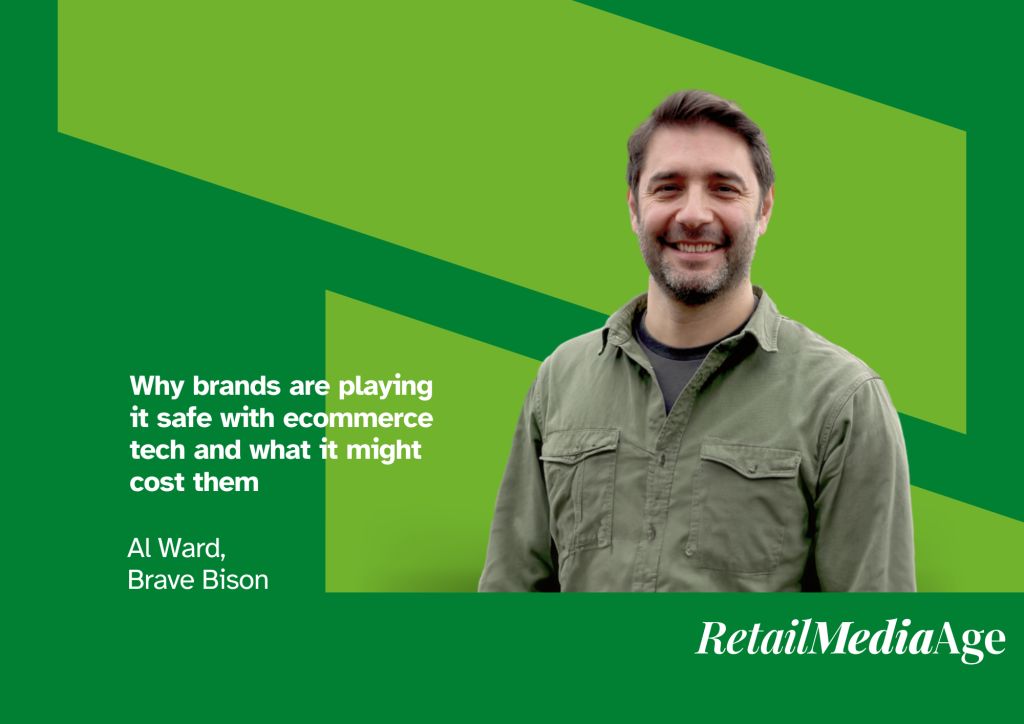
By Al Ward, VP of Commerce at Brave Bison
Economic uncertainty has made many retailers cautious. The years of sweeping ecommerce replatforming projects have given way to something more modest: making the most of what is already in place.
Instead of investing millions in new systems, brands are focusing on site speed, user experience, checkout flows and personalisation, the smaller, safer changes that can still deliver noticeable returns.
It is a pragmatic approach, but one that raises an uncomfortable question. Can incremental improvements keep pace with rising customer expectations, or will caution today mean lost ground tomorrow?
The pressures behind caution
The reasons for this shift are not hard to trace. Most ecommerce teams are already stretched close to capacity. Running at high utilisation, they often lack the time or resources to manage complex replatforming programmes alongside day-to-day operations. In some cases, organisations are still in the middle of other large technology projects, such as ERP upgrades, making it difficult to take on more upheaval.
There are also commercial realities at play. While some retailers have begun to post stronger results, confidence is still fragile. A leading furniture retailer recently reported more positive performance, but this has not been enough to trigger a wave of fresh ecommerce investment across the sector. The green shoots are there, but growth is not yet consistent enough to justify wholesale transformation.
In this climate, it is little surprise that many retailers prefer to sweat the assets they already have. It is less disruptive, less costly, and easier to justify to boards still wary of another period of overextension.
Small steps, big gains
This caution does not mean a lack of progress. On the contrary, smaller-scale improvements are often delivering impressive results. For high-traffic retailers, AB and multivariate testing can provide statistically meaningful insights into customer behaviour, leading to refinements that nudge conversion rates upward. For others, simplifying checkout or tightening up mobile UX has a direct impact on sales.
Examples of streamlined journeys are easy to spot. Patch Plants, for instance, offers a clean product listing, concise detail pages and a checkout so straightforward it is a pleasure to use. The experience speaks directly to its audience, often new homeowners or people who know little about plant care, by making information digestible and the purchase process reassuringly simple.
ASOS, too, has long been admired for its frictionless checkout, while Amazon sets the gold standard for speed and convenience. These benchmarks matter, because they shape customer expectations across every category. A shopper who breezes through a fashion site will be less tolerant of a clumsy, over-complicated journey when buying homeware or electronics.
Incremental optimisation also helps avoid the pitfalls of large-scale change. Rather than months of upheaval and risk, small gains accumulate quietly. Yet, as effective as these steps can be, they also create a temptation: to believe that fine-tuning alone will be enough to remain competitive.
The risk of standing still
Customer expectations are not static. Amazon continues to drive the standard for discovery and speed, conditioning consumers to expect instant results and one-click purchases. Competing directly with that model may be unrealistic for smaller retailers, but even mid-sized players cannot afford to ignore the pressure it creates.
The challenge is particularly acute for established brands whose digital platforms have grown unwieldy over time. Too many stakeholders often lead to checkout journeys that feel cluttered and confusing, with extra forms, prompts and distractions that only serve to increase basket abandonment. Funnel analysis can help identify where drop-offs occur, but unless these deeper structural issues are addressed, optimisations risk being little more than patches on a leaky system.
There is also the danger of complacency. The more brands become accustomed to incrementalism, the more vulnerable they are to being outpaced by competitors willing to invest in more transformative change. In fast-moving sectors, what feels like prudence can quickly turn into stagnation.
Looking ahead
The real test of today’s cautious approach may lie in the technologies just beginning to reshape ecommerce. One example is Google’s AI search overview, which presents information directly within search results. As this becomes more widespread, retailers risk losing organic traffic to their own sites unless they adapt SEO and content strategies accordingly. In practice, that could mean fewer customers ever reaching a checkout page, however well optimised it may be.
Omnichannel adds another layer of complexity. For retailers with both physical and digital storefronts, the challenge is to align the two. Online browsing increasingly drives in-store purchases, yet tracking and attributing that journey is far from straightforward. Some retailers are experimenting with nudges that link online browsing history with in-store service, but most are still in the early stages of connecting these dots.
Taken together, these shifts suggest that the current preference for safe, incremental improvements has a limited shelf life. Optimisation is valuable, but it must be part of a broader strategy that prepares for new ways customers discover, research and buy products.
For now, playing it safe may be a sensible response to economic pressures. But if caution hardens into idlement, retailers risk being left behind. The brands that thrive will be those willing to balance short-term pragmatism with a clear-eyed view of where customer expectations and technology are heading next.