The retail media landscape is navigating a pivotal transition from a burgeoning trend to a fundamental pillar of the marketing mix. At a recent Madfest North panel session, industry leaders gathered to dissect the hurdles preventing full maturity, the need for standardisation, and the critical importance of keeping the shopper at the heart of the strategy.
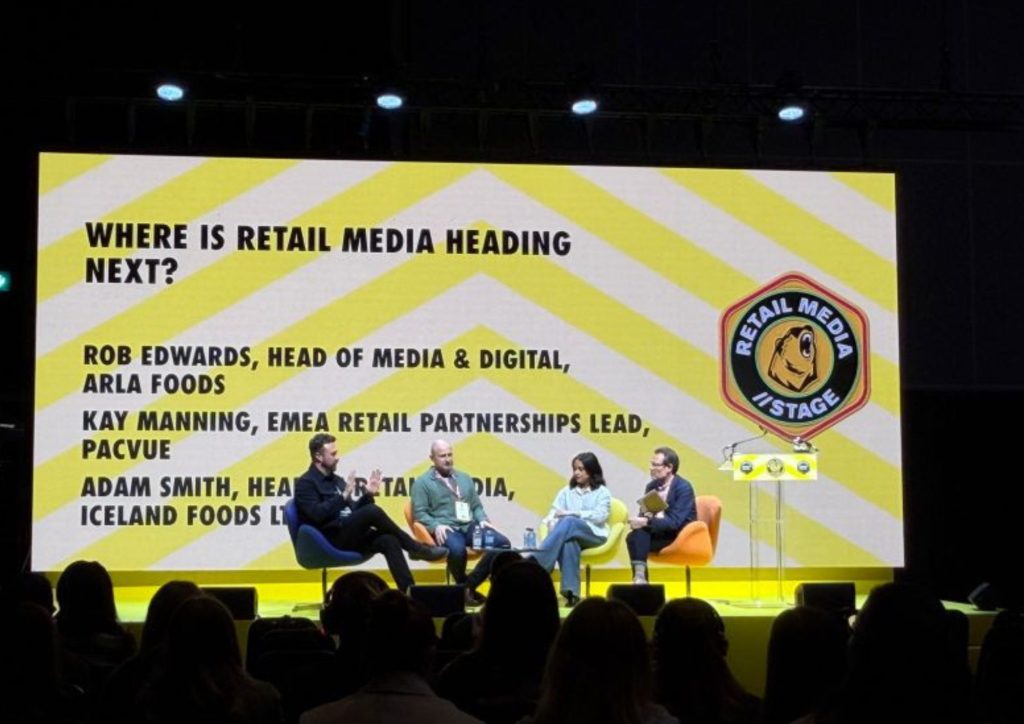
The discussion, chaired by Justin Pearse, Editor-in-Chief of Retail Media Age, featured a diverse range of perspectives from Rob Edwards, Head of Media & Digital at Arla Foods; Kay Manning, EMEA Retail Partnerships Lead at Pacvue; and Adam Smith, Head of Retail Media at Iceland Foods Ltd.
The maturity myth
Despite the rapid growth of the sector, the panel reached a consensus that retail media has “not quite” reached maturity. Rob Edwards grounded this perspective in the very terminology used today, stating, “I’m going to say no [to maturity], because we’ve still got the word ‘retail’ in front of ‘media’”.
For Edwards, true maturity arrives when the channel is viewed simply as another strategic lever within a brand’s media stack. He emphasised that for brands, “the foundations of measurement and getting those principles right is really important”.
Manning added that the pace of adoption is inconsistent across different retail sectors. Drawing on her background at Selfridges, she noted that “luxury retail is also really nascent to retail media”. This lack of uniformity indicates that while major players are well-established, the broader industry is still finding its footing as more diverse retailers enter the space.
Measurement: The “Golden Goose”
A dominant theme throughout the session was the industry’s struggle to achieve consistent, incremental measurement. For many brands, a fully realised closed-loop system remains an aspiration rather than a reality.
Edwards described incremental growth as the “golden goose” for advertisers. He argued that retailers must prove media spend drives new sales rather than cannibalising existing organic ones. “Retailers need to turn up and go, ‘we believe in our data, we believe it will deliver on your jobs to be done’”.
Smith concurred, saying that Iceland is focused on demonstrating the value of in-store media through measurable results. He cautioned that “incrementality comes with measurement” and warned retailers against simply “moving money around” from traditional trade budgets to retail media without providing added value.
The consumer experience: the forgotten stakeholder?
The panel offered a pointed critique regarding the current focus on data monetisation, suggesting it often comes at the expense of the shopper.
“The one thing we can’t ignore is the consumer experience,” Edwards warned, saying that “consumers are often forgotten all the time in this industry”. He called for a “seamless journey from sofa to store” and advocated for “attentive engagement” where creative content is specifically tailored to a shopper’s mindset, whether they are “on a mission” for essentials or simply browsing for inspiration.
Smith echoed this need for balance, particularly regarding in-store digital screens. He said that screens “must add value,” aiming to inspire customers with “recipe ideas or meal solutions” rather than simply “shouting at them”. Smith emphasised that intrusive or “noisy” digital formats risk damaging a retailer’s brand identity.
Fragmentation and the path forward
Looking toward 2027 and beyond, the panel identified fragmentation as a significant challenge. As more retailers launch individual networks, the burden on brands and agencies to manage bespoke specifications increases.
Manning pointed out that standardised global or regional campaigns are difficult to achieve because “each country has got its own biggest players”. Edwards that suggested the industry must move toward a “MAP” model – Mergers, Acquisitions, and Partnerships – to foster better collaboration.
The discussion concluded with a look at future technologies, predicting that AI and “agentic commerce” will redefine the industry. Edwards cited a prediction that “by 2038, 50% of marketing budgets will be spent agent-to-agent”.
Despite these high-tech forecasts, the panel agreed that the immediate goal is perfecting the “boring but important” foundations. As Manning summarised, the ultimate objective is to make retail media “more integrated but less intrusive,” eventually dropping the “retail” prefix to simply be recognised as media.