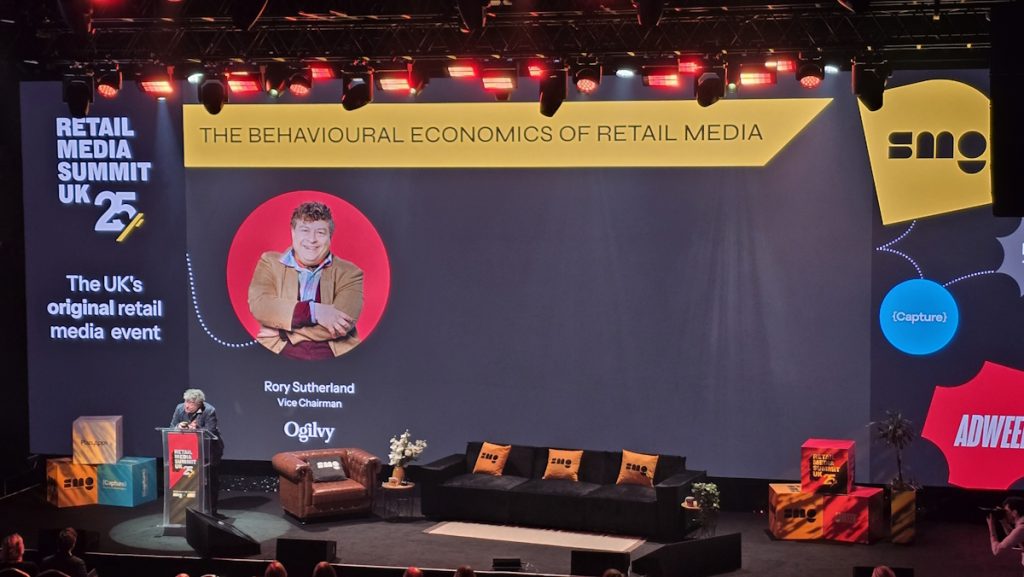
When Rory Sutherland takes the stage, the audience knows they’re in for a ride. And, speaking at SMG’s Retail Media Summit 2025, Sutherland didn’t disappoint.
As is the norm, the Ogilvy UK Vice Chairman, behavioural science evangelist, and self-proclaimed “marketing heretic” offered equal parts wit, wisdom, and well-aimed provocation during the session (which overran by about 40 minutes) about how and why retailers and brands need to start thinking differently about marketing.
The power of the “small, silly” idea
Sutherland opened with some suggestions for retailers: putting the sugar cubes next to the teas and coffees, because “no one’s going to use sugar cubes for baking;” grouping dishwashing and laundry products together, because “in my own brain they’re the same thing;” moving the ice and lemons & limes to the “booze section,” because “all the shit you need to mix the spirits is at the other end of the supermarket;” and placing additional shopping baskets in areas away from the entrance, because people often end up buying more than what they intended and, if they don’t take a basket when they enter the store, they’re left having to hold the items in their arms.
These may seem like throwaway suggestions, but these “small, silly ideas” represent simple tweaks that can change behaviour by changing context.
“Behavioural science,” he reminded the audience, “is about understanding the frame in which choices are made. Change the frame, and you change the outcome.”
For Sutherland, retail’s obsession with metrics has blinded it to what actually drives people to buy. “You can’t A/B test your way to magic,” he quipped. Retailers, he argued, have become so fixated on measurable efficiency that they’ve lost sight of emotional resonance — the feeling that a brand or shopping experience means something.
“Most marketing,” he said, “isn’t about logic; it’s about meaning. People don’t buy what makes sense; they buy what feels right.” In that spirit, he urged marketers to spend less time optimising what’s easy to measure, and more time exploring what makes people smile, stop, or share.
Rethinking digital marketing
One of his sharper provocations was aimed squarely at the emerging world of retail media and trade budgets. “Retailers,” he said, “spend vast amounts of money persuading brands to spend more, but almost none of that thinking is creative.” His challenge: treat trade investment with the same imagination and behavioural insight that consumer marketing enjoys.
“Even 10% more creativity in how you use those budgets,” he said, “would have an exponential effect.” Retail media shouldn’t just be another transactional channel — it’s an opportunity to influence perception, context and choice in real time.
Sutherland’s critique of digital marketing’s “efficiency obsession” was as pointed as ever. “We’ve built a machine for exploiting what we already know,” he said, “but we’ve forgotten to explore what we don’t.”
In retail terms, that means experimentation. Testing new layouts, surprising adjacencies, or rethinking the shopper journey. “Sometimes the best discoveries come from what doesn’t make sense,” he added. “If you only ever optimise, you never innovate.”
While Sutherland clearly respects data, he warned against mistaking it for truth. “Metrics tell you what happened,” he said, “not why it happened.” Retailers, he suggested, should pay as much attention to the psychology of shopping as to the spreadsheet.
That means understanding the “non-conscious shopper,” according to Sutherland. “The human mind doesn’t run on logic. It runs on stories, shortcuts, and signals.”
This all plays into the world of quarterly results and short-term targets, but Sutherland urged retailers to look beyond these and start thinking more like family-owned/-run/-operated businesses.
“When you’re focused only on efficiency, you lose resilience,” he said. “When you chase ROI, you miss loyalty.”
For him, the most successful retailers are those who build meaning over time. Those who understand that trust and affection can’t be bought by discounts alone. “People come back,” he said, “not because you were cheapest last week, but because they like how you make them feel.”
Making sense of it all
Sutherland’s message was equal parts critique and call to action. Retailers, he said, must rediscover curiosity. “Don’t just look for what’s rational,” he urged. “Look for what works.
“Not everything that makes sense works. And not everything that works makes sense.”
That might mean giving creativity and behavioural science bigger seats at the data table — or simply moving the sugar cubes and certain citrus fruits in-store.