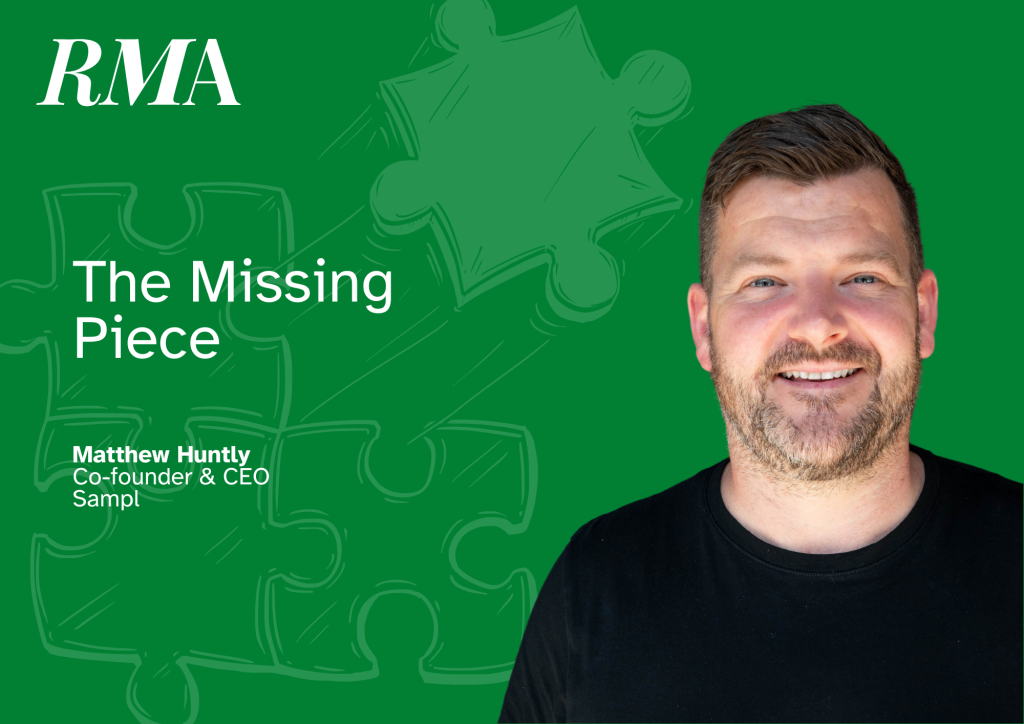
‘The Missing Piece’ is a series where we ask the retail/commerce media tech platforms how they are addressing the challenges facing the ecosystem.
The first article features Matthew Huntly, Co-Founder & CEO at Sampl, a product sampling platform.
What excites you about the retail media landscape as a whole?
Even after years of growth, retail media is still in its formative years. What’s exciting is how quickly the landscape is diversifying. Amazon may have set the benchmark and dominated early conversations, but we are now seeing a wave of retailers building their own media networks and bringing differentiated, first-party data into play. This is healthy for the ecosystem – it creates more choice for brands and pushes innovation across formats, targeting, and measurement.
The most exciting part is that brands are no longer confined to thinking purely about reach or share of voice. They can link their investments directly to outcomes that truly matter to the business – driving trial, generating verified reviews, lifting conversion, and ultimately shifting sales. The convergence of media, commerce, and shopper behaviour data means retail media can finally deliver a closed-loop view of performance. For those of us who have long advocated for measurable marketing, this feels like a breakthrough moment.
What are the biggest challenges facing the ecosystem?
The biggest structural challenge is fragmentation. Each retailer is creating its own network, its own ad formats, its own reporting environment, and even its own language. For brands, that makes it incredibly difficult to compare performance across partners or build a unified view of their retail media investment.
This challenge is amplified by budget pressure. Marketers today are expected to justify every penny they spend. Simply reporting impressions or clicks is no longer enough – campaigns must prove they are driving real business outcomes, whether that’s trial, conversion, or repeat purchase. Until measurement becomes more standardised and comparable across retailers, marketers will struggle to unlock the full potential of retail media as a growth engine.
How does your business aim to solve those challenges?
We see an opportunity to bring more rigour and measurability to one of the oldest tactics in the book: product sampling. Traditionally, sampling has been seen as a cost centre – a way to build awareness or encourage trial, but difficult to track back to meaningful results.
Our model is about changing that perception. Through partnerships with retailers like THG – including LOOKFANTASTIC, Cult Beauty, and Dermstore – we ensure samples reach the right audience at the right moment in their purchase journey. More importantly, we close the loop by capturing reviews, first-party data, and engagement metrics, and connecting those results back to retail performance. It’s about making sampling accountable, so brands can treat it with the same level of scrutiny and confidence as the rest of their retail media mix.
What has been your biggest success so far?
Ole Henriksen is a case study we often come back to because it demonstrates the speed and scale at which sampling can move the needle. Working with THG, we distributed samples to a highly relevant audience and captured 682 verified reviews across LOOKFANTASTIC and Cult Beauty in less than two weeks.
Conversion rates doubled, the product climbed 12 spots in its sales ranking, and 96% of reviewers were completely new to the brand. In other words, sampling not only drove trial but also brought new customers into the franchise and boosted its overall visibility on key retail platforms. It is a clear proof point that when executed strategically, sampling can be a growth lever – not just a brand-building exercise.
What do you think the future holds for both the business and the wider world of retail media?
The future of retail media will be defined by proof of impact. As the channel matures, brands will demand a higher standard of evidence – not just who saw an ad, but whether it shifted behaviour. Did it drive trial? Did it generate reviews that influence other shoppers? Did it lead to repeat purchase and loyalty? These are the metrics that will matter.
For us, that means continuing to evolve our capabilities: partnering with more retailers, enhancing our targeting to reduce waste, and investing in measurement tools that give brands confidence in the return on every campaign. The aim is to create a world where sampling is not a side activity, but a fully integrated and measurable part of the retail media mix.