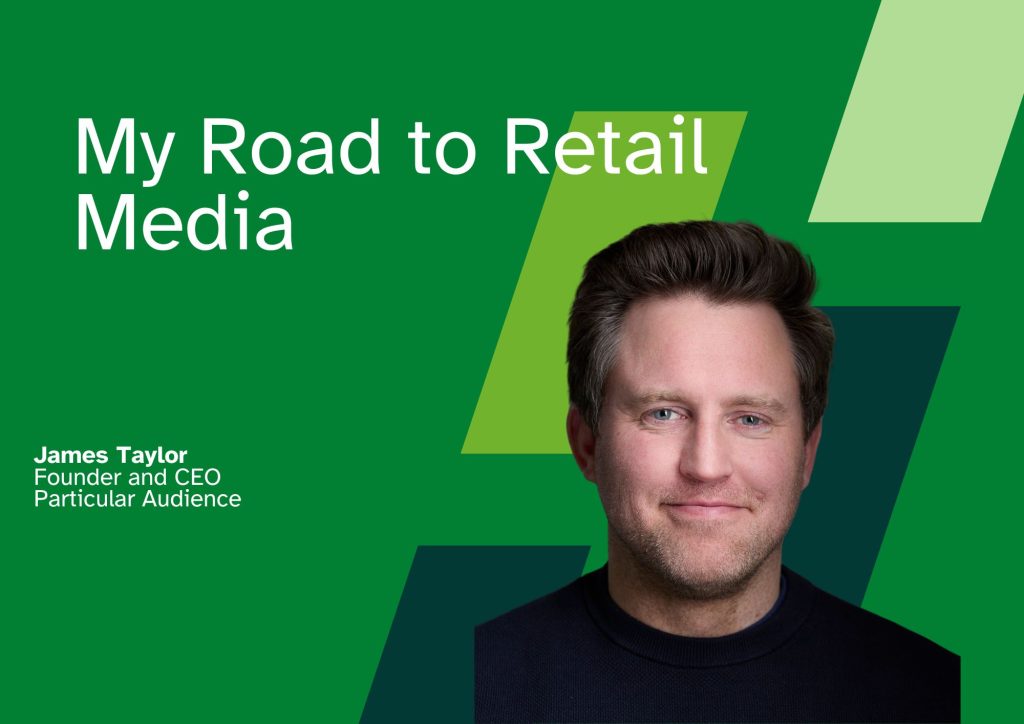
James Taylor is Founder and CEO at Particular Audience, an AI-native retail media and personalisation platform that unifies proprietary large language powered search, hyper-personalisation, and sponsored product ad decisioning into a single ranking system. We asked how he arrived in retail media.
What is your role and what does it entail?
I am the Founder and CEO of Particular Audience. My role is defined by a mission to “democratize the technology that makes Amazon great,” providing innovative people at the world’s leading retailers with the tools to compete with Amazon across the customer experience interface.
I spend my time ensuring Particular Audience supports our clients in bridging the gap between advanced artificial intelligence and practical ecommerce applications. Strategically at the moment, my role is to make retail media as flexible and low cost to iterate and experiment with as possible. Agility is what success depends on for retailers wanting to unlock ad revenue as a profit centre.
How did you first become interested in retail media and move into it?
I have spent my career involved in prediction science. I studied capital markets and investment at university and wrote a dissertation on fundamentals versus sentiment in asset valuations.
After graduating, I started my career in investment banking working on valuation and predictive models. At 23, I then co-founded a (now defunct) prediction markets startup, I subsequently joined a personalisation tech startup backed by Google and SoftBank to build their APAC business, in which we supported brands including Adidas and Vodafone in their ecommerce conversion rate optimisation. That company was recently acquired by Epsilon Publicis.
I believe that good personalisation is just good prediction.
Having built a personalisation business that hinged on human hypothesis, rules and manual work, I felt like there had to be a smarter approach. It was 2017 and I wanted to learn about AI and machine learning as the next big thing, and especially how it could benefit retailers and brands in personalisation.
I stumbled across the former head of technology from Amazon, who had co-authored a book called Mining Massive Datasets. After getting my head around some tricky concepts, I fell in love with recommendation systems and learned how they shaped our digital experiences on major platforms – where most retailers were still stuck with manual targeting and manual merchandising approaches.
I saw the opportunity to democratise this technology for retailers, so I left my job and invested my life savings into building Particular Audience.
As we launched, in 2018 I noticed some early ‘Sponsored Product’ labels on product tiles on Amazon.com and thought it was a brilliant idea, so we got to work enabling this functionality in PA.
The rest is history.
What most excites you about the industry today and what might happen next in RM?
I’m excited about the end of the era where retailers are locked into a single monolithic and closed “black box” platform.
PA recently announced our Modular Retail Media platform: a “MACH moment” for the industry. In February, we are launching the first Shopify App that enables one-click retail media integration for retailers on Shopify, and our tag-based integration removes all the work and cost for retailers on other platforms wanting to get live as quickly and cheaply as possible.
As the cost of integration and ownership drops, retail media will see an explosion of creativity, rapid experimentation and innovation. PA is here for it.
It’s our mission in 2026 to enable RMNs with the agility to win in a market that has to date been terribly slow-moving on tech.
Who is your biggest inspiration in the retail media sector and why?
Anand Rajaraman pioneered the use of statistical and machine learning approaches to personalisation both at Amazon and then later at Walmart by embedding sponsored products and ads within the same systems that power their product discovery and personalisation. It has allowed them to scale to be some of the most formidable, high-growth and margin-accretive retail media platforms in the world.
Mercado Libre, Flipkart and others have followed suit. It is inevitable that the rest of retail will soon realise that manual campaign setup and rules-based segment and keyword targeting is not the future, and that retail media should exist within the same decision systems and ranking logic that powers organic search and discovery on their websites. Good advertising should be indistinguishable from organic relevance.
What one retail media campaign or strategy you’ve been involved in are you proudest of?
It’s hard to pick a favourite, but I think that Petbarn in Australia has the strongest on-site retail media offerings in the world outside of Amazon.
They balance retail media activity with private label and merchandising goals across an optimised and personalised customer experience across web and app. For brands such as Mars, the automation enables performant reach at scale, especially as the number of retail media networks these brands might consider increases every month.
For the retailer, retail media doesn’t come at the expense of sales, but instead sales and advertising margin is optimised holistically. It’s the perfect blueprint.
My favourite campaign was from dental treat brand ‘Greenies’ that as a challenger brand and newer growth category has a tonne of upside with retail media. Through creative takeovers and full funnel personalised placements to new but high-potential customers, they saw 59.3% of transactions come from new to brand customers with incremental impact from their multi-touch on-site campaign.
This included: share of voice up +202%; share of basket increasing by a whopping +13.74%, demonstrating a sales increase of +13.26% over prior period; and notably, repeat order purchase frequency shortened (improved) by 6.68%.
They demonstrated that education, awareness and physical and mental availability combine to drive sales uplift. It is the quintessential on-site retail media best practice.