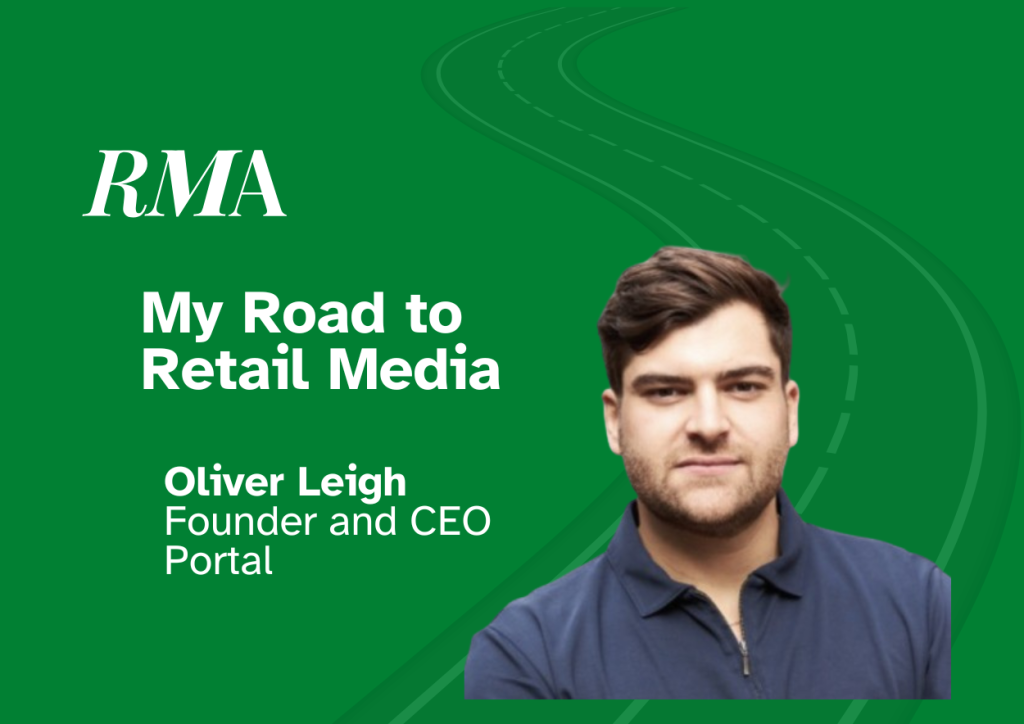
Retail media continues to attract huge investment from brands and retailers alike, but measurement across the full customer journey remains a challenge. Oliver Leigh, Founder and CEO of Portal, believes the key opportunity lies in connecting offsite media activity with onsite retail performance.
In this interview with Retail Media Age, Leigh discusses his background in advertising, how he arrived in the retail media sector, the measurement gap Portal has set out to address, and what the future of the industry might look like.
What is your role and what does it involve?
I am the Founder and CEO of Portal, so ultimately I am responsible for the overall direction of the business. My focus is on business strategy and shaping the direction of the product, working closely with my co-founder who serves as our chief technology officer.
My co-founder leads our data, security and technology development, while I oversee areas such as sales, marketing and commercial partnerships. In a young company you naturally wear a lot of hats, but our main goal is building technology that helps brands better understand the relationship between their media activity and retail performance.
Portal was founded to solve a very specific problem that we repeatedly saw when working with consumer packaged goods brands. These companies invest heavily in retail media but also spend significant budgets on offsite advertising that drives shoppers to retailers. The challenge is that they receive very little data from retailers about what happens when those consumers arrive on those sites.
How did you find your way into retail media?
I have spent my entire career in advertising, starting in out of home. Like many people in the industry I fell into it somewhat by accident, but I quickly became fascinated by how advertising actually works and, more importantly, how it is measured.
That curiosity led me into digital advertising, where measurement and attribution became a major focus of my career. I have worked with a wide range of technologies, including data platforms, demand-side platforms and location technology, and I have also spent time working in markets such as Australia and across APAC.
My introduction to retail media came through my time working at a business called Player Cart, where I was the first employee. My current co-founder was the CTO there, and through that experience we began to see the enormous growth of retail media as well as the gaps that existed within it.
What we realised was that brands often had a strong understanding of their on-site retail media performance but very little visibility into how offsite media activity influenced those outcomes. That gap in measurement was the problem we set out to solve with Portal.
In your view, how interchangeable are retail media and commerce media? Are they the same thing?
It depends on how brands structure their teams and strategies. Some brands treat all media that drives sales through retailers as retail media, while others make a distinction between ecommerce marketing and retail media activity on retailer platforms.
In many organisations those activities are handled by completely different teams. You might have a media agency running awareness and consideration campaigns offsite, while trade or commerce teams are responsible for buying media directly from retailers.
The challenge is that those teams often operate in silos, which means the full customer journey is never properly understood. From my perspective the industry should move towards a more integrated model where the same team plans the entire lifecycle of the customer.
Ultimately the goal is a closed loop view of the journey, from awareness through to purchase. If offsite and on-site activity remain separated organisationally, those connections are extremely difficult to make.
What excites you most about retail media right now?
The most exciting element is the data. Retailers have an incredibly rich view of how consumers behave, particularly companies like Walmart, Amazon and others that have built sophisticated retail media networks.
However, there is still a major challenge in terms of how that data is reported and used. Each retailer measures performance in slightly different ways, which makes it difficult for brands to compare results across platforms.
For the industry to reach its full potential we need greater collaboration and standardisation around measurement. If retailers and brands can successfully connect those data points across platforms, everyone benefits.
Brands sell more products, retailers generate more revenue from both sales and advertising, and consumers ideally receive more relevant experiences. It is one of the few areas in advertising where there is a genuine win for every party involved.
Who has been the biggest inspiration for you in retail media?
Someone whose work I really enjoy following is Mike Feldman, who is now at Flywheel. What I appreciate about his perspective is that he talks about both the opportunities and the potential risks within retail media.
He keeps a close eye on industry developments and consistently shares thoughtful insights on where the sector is heading. One example he raised recently was how agentic commerce could impact retail media, particularly the heavy reliance on sponsored search within retailer environments.
If consumers increasingly rely on AI agents to navigate retail sites and make purchases, those agents may go directly to the relevant product pages rather than using search. That could fundamentally change the role that sponsored search currently plays in retail media.
I think voices like his are important because they help the industry think critically about the future rather than simply celebrating growth.
Is there a piece of work you are particularly proud of?
One example that stands out is our work with the consumer health company Karo Healthcare. They produce well-known brands such as E45, yet they operate largely behind the scenes compared to some household consumer brands.
We helped them implement the Portal platform to understand how their offsite media activity influenced consumer behaviour on retailer websites. By connecting those data points we were able to give them a much clearer picture of how shoppers moved from advertising exposure to purchase.
That insight allowed them to optimise their offsite media campaigns and send more accurate conversion signals back into their platforms. As a result they were able to improve campaign performance and grow market share for several of their products.
For us, that case study demonstrates the value of connecting the offsite and on-site parts of the retail media ecosystem. It shows that when brands understand the full customer journey, they can make much smarter decisions about where to invest their media budgets.
Read more about how industry leaders got started in retail media in our My Road to Retail Media series.